Peter's already alluded to the existence of a story behind our staying in Gondar for nearly a week (it felt much longer). Indeed while Gondar has much to recommend it (e.g., fine churches, rugged landscape, an impressive castle), I can't image many travellers voluntarily choosing to spend such a period of time there.
The basic fact is this: while riding my motorcycle on the busy 10 kms of road from Gondar to Azézo, I collided with a small child. Such an event is every overlander's nightmare and, for reasons that will become clear, the depth of the trouble is greatly magnified by the punitive and irrational nature of Ehtiopian traffic laws.
It was just before 9am and we (finally) departing Gondar in a convoy of five KLRs (!!!), having spent the previous day with Tom, Tyson and Yeremy at Six's first repairing and then haggling, with some urgency. Everything felt great: the temperature was cool, there was beautiful sunshine, the road ahead is every motorcyclist's dream and we were making an early start that ought to have put us within striking distance of Addis and therefore nearly back on schedule. All of a sudden, I nearly ran squarely into a pack of mules that came quickly out onto the road, seemingly from nowhere. Slightly separated from the lead pack, I reminded myself to take it slow on these unpredictable roads with their multi-dimensional challenges.
I pulled the bike into the centre of the road, as Peter says 'the safest place to ride a motorcycle', and checked my speed at about 50kms. All of a sudden, out of my left peripheral, I saw a streak. That was all the warning I got. There was really no time to react beyond a slight shift to the right in a vain attempt to swerve and sudden application of the brakes. The crunch was sickening and I knew immediately what had happened. After stopping the bike on the side of the road, I looked back and saw a small boy lying motionless near the left verge of the road. I feared the worst. Physically, I could barely bring myself to approach the scene.
Luckily the blow had been glancing rather than direct, since the boy had been running diagonally (with his back to oncoming traffic) instead of directly across the road. Clearly he had run out, most likely to catch his friends on the other side, without looking. Perhaps he believed the way was clear after watching the first pack of three bikes pass. In any case, I can say with a clear conscience that I am not even guilty of letting my attention drift; there was nothing I could have done to avert this collision.
The boy, Gashaw, 12, had broken tibia and fibula in his right leg and had taken a worrisome bump on the head. (As we left town his condition and prognosis had improved significantly; the hospital was preparing to discharge him completely to his family's care.) Immediately after the accident, someone from the gathering crowd urged me to put him on my bike and take him to the hospital. This seemed both impractical and dangerous, but before I could react, a man quickly gathered Gashaw's lifeless form, jumped into a crowded minibus, which then raced from the scene. The crowd then insisted that I wait for the police; a seemingly sensible course of action which we accepted (by this time the other riders had returned to the scene). I was encouraged by the occasional translation of witness accounts which invariably corresponded with my own experience; the accident was caused by the boy's carelessness.
In retrospect, waiting for the police was the right decision, even if it was not the wise course of action. While I have broken some laws and regulations in my life (e.g., speeding), I do respect the law and the police, but in this case the police were clearly working against my interests and the law was stacked against me. But even if leaving the scene of the accident could have saved me and my friends some grief, ethics demanded that we confirm the status of the boy's health.
Once the police arrived, in effect, the next phase of the proceedings began: the legal wrangling and financial haggling. Here's the rub: it turns out that Ethiopia has an administratively simple but outrageously unfair law that makes any vehicular accident involving a pedestrian the sole fault of the driver. Not only does this strain reason and 'justice' by any definition, but it flies in the face of the reality of Ethiopian streets where pedestrian do the stupidest things with abandon and regularity. One can't help but wonder if the street life in that country might be just a bit more orderly if this law were amended.
The bottom line is that I was civilly and, potentially, criminally liable for Gashaw's injuries. A government official told me that if Gashaw were to die, the sentence would be an automatic 17 year sentence. That was indeed a cold shower. But criminal charges seemed unlikely given two facts. First and most importantly, Gashaw's injuries did not seem 'grave' (that is the translation of the legal term most folks were throwing around). It was here that Yeremy and Tyson, medical students back in Canada, came to my rescue. They visited Gashaw in hospital on two occasions, speaking with the doctors and family, getting the latest prognosis, assessing the quality of the care and even leaving some of their personal stock of painkillers. They reported steady improvements and, most importantly, that the head injury did not appear serious or permanent in any respect. Irrespective of the remoteness of criminal charges, the term 'prison' slowly started to rear its head more frequently in discussions between the police and the flaky lawyer I engaged (he subsequently left me in the lurch).
The civil liability was more tricky and ultimately proved tortuous. I still find it hard to believe that I was held liable for an accident caused exclusively by someone else. In any event, the civil liability was a matter to resolve with the family or, if we failed to reach an agreement, in the courts. A court resolution would have meant the end of the trip and a lengthy stay in Ethiopia; neither of which were realistic options. Settling with the family was the only realistic option. Let the haggling begin.
These were not truly negotiations in the classical sense of two parties sharing and withholding information, seeking to swap items in a manner that creates value for both sides. This was haggling in its most basic sense. In fact, we didn't even need a translator or a common language. All we really needed was some time, a slip of paper and a pen with which to write our latest offer and counteroffer. The first demand was for slight north of US$10,000. We failed to reach a settlement that day.
Throughout that first day and the one that followed, my position was considerably weakened by the gleeful meddling of the Gondar police, who frankly seemed to revel in the whole sordid spectacle. The police played their role of slowly sawing away just above my knees by a) holding my bike as a 'prisoner', b) similarly holding my passport and driver's license, and c) ever increasing the frequency of prison talk in the presence of the family.
The only thing we could do shift the balance was to introduce some community pressure into the equation. In this regard, as with many others (e.g., when the bailiff finally arrived to enact the police chief's order to lock me in the slammer, Peter was there to insist that they first call our embassy in Addis and to escort me off the premises amidst much yelling and some clutching at my sleeves), Peter was super helpful. He tracked down a British woman called Kate who was married to a resident of Gondar and was also an active member of the community. She suggested getting some of the 'elders' involvement. She also suggested that a truly reasonable settlement might be about US$100-200. (Apparently a Canadian couple several years back had paid an amount equivalent to US$4,000 at today's exchange rate after the accidentally death of a child.) While her analysis of the 'reasonable' amount was slightly off – she discounted that we couldn't credibly argue that we were willing to try our chances in court because of the opportunity cost of time – her advice to seek some informal counsel ultimately advanced the negotiations considerably.
Ultimately, I hesitantly and unhappily paid the grandfather about C$1,700. Gashaw's medical expenses were expected to be less than $100. The payment felt unjust, injurious and distasteful in that I was supporting those who would seek to profit from the injuries of their loved ones. Perhaps this is small-minded of me, but even after some deep reflection I cannot see another alternative. Beyond the basic facts of the case, my impressions are coloured by several important events from the negotiations: the grandfather refused to shake my hand after I bade him 'salaam' the day after the accident; the opening demand of $10,000; the look of glee and greed on the faces of the family members as they counted their windfall as the police looked on 'neutrally'.
We were glad to leave Ethiopia. We had the impression that the children of Ehiopia, with their sticks and stones aimed at our helmets, shared this sentiment.
Thursday, July 31, 2008


So Far Away From Me
I write from Nairobi. We've arrived after far too many days in Ethiopia and a rather harrowing ride down the Bandit Road.
We last wrote from Gonder where we had arrived after a night spent on the road in the mountains. After that day we took our bikes into be serviced at Six's in Gonder. He's a rather famous mechanic and he did fine work. He's also willing to try his hardest to rip off foreigners. He tried to charge us $1000 US for less than a day's work. We didn't bite but all future overlanders should be forewarned.
After two days in Gonder we started out for Addis. We didn't make it far before we had to turn back. It's Sam's story to tell and I shall leave it to him. For now I will just say two things. First, we spent four days in and out of various government offices; at one point narrowly avoiding an arrest by bluffing that it was Sam's right to call our embassy before detention by the police. As the police station had no functioning long distance phone and no police officer had credit on their mobiles we walked away. It's a two-bit affair in Gonder. Second, I've never been more impressed by Sam's composure and level-headedness. And those are two qualities you want in a person you are relying on to go with you across a continent.
We finally left Gonder and headed to Moyale at the Kenyan border. We made the journey in two and a half days, but not before having our breath stolen by the beauty of the Ethiopian countryside and the Blue Nile valley. And not before having several sheppard boys throw rocks andswing sticks and whips at us as we rode by. Indeed, our friend Steffan was nearly knocked off his bike by a boy (more likely a teenager based on his size) who had a real home run swing. This lead to a rather nasty confrontation with a series of villagers that ended with the boy's umbrella shredded in pieces. It's rainy season in Ethiopia and it's going to be a wet one for the boy. It's rough justice in Ethiopia.
As if to confirm how rough this justice is, I was hit on the head by another sheppard boy five minutes down the road. This too almost caused a crash and lead to another rather heated and badly communicated confrontation with a series of sheppards. By the end of our time in Ethopia we became accustomed to whips on the back and rocks to the windscreen. It's enough to say it soured me on the country a little.
We crossed into Kenya at Moyale and began our journey down the shifta or bandit road. It's worse than I ever imagined. The road is a 510 km track of washboard and lava rocks broken up in the middle by the town of Marsabit, perched on the side of a volcano, and ending at Isiolo where the tarmac to Nairobi begins. We were making great time on the first day before hitting the lava field at kilometer 120 or so. Within forty kilometers we both had flat rear tires. We spent an hour working on the tires in the heat before paying a driver to put them on a truck and take us to Marsabit where we repaired the tires the next morning. We rode with the forty other passengers who snoked compulsively despite the dozens of leaky kerosene containers and who were constantly concerned we were going to steal their packages. We arrived in Marsabit in the dark.
We left for Isiolo the next afternoon. We were again making great time, flying over the washboard at 80 km/h. But something had to give and I blew my rear shock at kilometer 160. We then slowly rode 70 kms to Archer's Post, mostly through the dark, where we called it a night. I had little control and crashed twice on the way, once pinning my leg under my pannier until Sam could pull me out. See 'compusure' and 'level-headedness.'
The next day we rode the final 30 kms of dirt to Isiolo and the 300 kms of tarmac to Nairobi. It was a bouncy ride for me, to say the least. We've spent the last day at Jungle Junction repairing the bikes. It's a legendary place for overlanders and well-deserving of its reputation.
We leave tomorrow for Arusha and then Dar. For those of you following the trip closely you'll know that this signals the excising of Uganda and Rwanda from our itinerary. We've lost too much time in Alexandria and Gonder to do this leg of our trip and we've cut it out with no small sadness. I've wanted to go to Rwanda for many years now, but it's still so far away. Another time.
We've had a lot of challenges on this trip and it's been much more difficult than expected. I've gone to bed quite discouraged on many nights. But I've also felt fortunate each morning to face another challenge and to have another day more interesting than the one before. I could write for a long time about the stark beauty of the things we've seen and the richness of the things we've done. The short version is that I am a lucky man to have seen such things.
It's going to be a race to Cape Town but it's something to which we look forward. It's so far away from us now.
Keep looking ahead. (And wish us luck!).
Gonder Show
This post is now ten days old. We've only now been able to send it up.
I write from Gonder, a beautiful Ethiopian city at the southern end of the Simian mountains. It's quite a place and we've had a great day so far. We can't say the same about last night.
When we last wrote we had arrive in Khartoum. I was nursing some sore ribs and a wounded pride and the desert had taken something out of Sam, too. Still, we departed from Kharmtoum with high hopes the next afternoon and we had a simply amazing ride to Gedaref. The change in landscape, housing, and people as you head towards the eastern border of Sudan is simply amazing. This is a country too complex to understand after one visit and we should hope to return someday.
We found a hotel that night with some great Italians we've been crossing paths with along the way. They deserve a post of their own. It is enough for now to say that we would not be writing from Gonder today if not for them.
After having dinner we returned to our hotel to find the proprietor dozing on a couch while two police officers insisted we reregister for the hotel. This is how two-bit police states work: you are asked to give your "fire" and "sure" names, these are put on a form, and then the form is most surely lost and never used again. But you must be careful not to balk too much at such a silly request. People here are jailed for taking pictures, for saying the wrong thing, for refusing to turn over passports to uninformed men without identification. So, this is the riddle of the Sudan: it's full of kind and honest people, it's blessed with a rich and diverse topography and no shortage of natural resources. But it's eating itself from the inside out and its President has been indicted for war crimes. It's a strange place.
We left the next day and crossed the border into Ethiopia. The change in wealth -- a steep drop, to be sure -- is striking. So is the bizarrely intense curiosity of the children and their habit of yelling "you, you, you" while asking for money, touching your bike, clamouring at your jacket and on and on. Don't take me as a person who does not understand the sources of this behaviour. I do, and I appreciate them. But it's quite a test of patience when one is changing a tire or one has just completed 20 hours on the road and is desperate for a tea and nothing else. Our day would include many such events.
Let me leave the description of our crossing to Gonder to short form, first because time is short and second because someone has donated good money to Spread the Net to get the first full account. But as I do, keep in mind that Gonder is only 210 kms from the Sudan border.
1.) We leave the Metema border station at 11 am.
2.) We clear customs 30 kms down the road by noon and finish lunch at 1.
3.) Sam soon notices he has a leaky back tire. It is not until 8 pm that it is fixed. The local tire guy and his crew of helpers do the job incorrectly several times. The Italians come and fix it.
4.) We begin the climb into and over the mountains to Gonder. It is dark and the dirt road climbs into another world. Our high beams tell us the mountains are green. Our ears tell us they are filled with animals. And some empty feeling in the stomach tells you not to ponder the edge. It is raining harder than I have ever experienced.
5.) I lose a ratchet strap which wraps in my back wheel getting into the brake and breaking three spokes.
6.) The Italian's truck breaks down. We take close to an hour to fix it on the side of the mountain.
7.) I get a flat tire in some muddy clay.
8.) We fix the tire, but no one can get out of the clay. It takes us some four hours to travel less than a kilometer. There is a breakdown in communication and I ride ahead three kilometers after I get going. The Italians stop to camp. Sam catches up with me and we pitch a tent on the road marking our spots with our bags. All of our warm clothes are on the truck. We freeze the night away. It must be 3 am.
9.) We wake up at 7 am to the roar of passing trucks. I leave the tent and find three sheperds staring at us. We pack and begin the ride again. The road has dried somewhat and the tracks passing by our tent have packed a trail. We head for Gonder, 30 kms down the road.
10.) Sam gets another flat. The patch from the local job didn't hold. We put his bike on a pop bottle truck and I follow them into Gonder. We arrive at 10 am.
11.) We find a local bike shop and a hotel. We share beer and pizzas with other overlanders we've met. The long day ends and we count ourselves lucky men to have seen and done such things.
We leave tomorrow for Addis Abeba. Keep well and keep looking ahead.
I write from Gonder, a beautiful Ethiopian city at the southern end of the Simian mountains. It's quite a place and we've had a great day so far. We can't say the same about last night.
When we last wrote we had arrive in Khartoum. I was nursing some sore ribs and a wounded pride and the desert had taken something out of Sam, too. Still, we departed from Kharmtoum with high hopes the next afternoon and we had a simply amazing ride to Gedaref. The change in landscape, housing, and people as you head towards the eastern border of Sudan is simply amazing. This is a country too complex to understand after one visit and we should hope to return someday.
We found a hotel that night with some great Italians we've been crossing paths with along the way. They deserve a post of their own. It is enough for now to say that we would not be writing from Gonder today if not for them.
After having dinner we returned to our hotel to find the proprietor dozing on a couch while two police officers insisted we reregister for the hotel. This is how two-bit police states work: you are asked to give your "fire" and "sure" names, these are put on a form, and then the form is most surely lost and never used again. But you must be careful not to balk too much at such a silly request. People here are jailed for taking pictures, for saying the wrong thing, for refusing to turn over passports to uninformed men without identification. So, this is the riddle of the Sudan: it's full of kind and honest people, it's blessed with a rich and diverse topography and no shortage of natural resources. But it's eating itself from the inside out and its President has been indicted for war crimes. It's a strange place.
We left the next day and crossed the border into Ethiopia. The change in wealth -- a steep drop, to be sure -- is striking. So is the bizarrely intense curiosity of the children and their habit of yelling "you, you, you" while asking for money, touching your bike, clamouring at your jacket and on and on. Don't take me as a person who does not understand the sources of this behaviour. I do, and I appreciate them. But it's quite a test of patience when one is changing a tire or one has just completed 20 hours on the road and is desperate for a tea and nothing else. Our day would include many such events.
Let me leave the description of our crossing to Gonder to short form, first because time is short and second because someone has donated good money to Spread the Net to get the first full account. But as I do, keep in mind that Gonder is only 210 kms from the Sudan border.
1.) We leave the Metema border station at 11 am.
2.) We clear customs 30 kms down the road by noon and finish lunch at 1.
3.) Sam soon notices he has a leaky back tire. It is not until 8 pm that it is fixed. The local tire guy and his crew of helpers do the job incorrectly several times. The Italians come and fix it.
4.) We begin the climb into and over the mountains to Gonder. It is dark and the dirt road climbs into another world. Our high beams tell us the mountains are green. Our ears tell us they are filled with animals. And some empty feeling in the stomach tells you not to ponder the edge. It is raining harder than I have ever experienced.
5.) I lose a ratchet strap which wraps in my back wheel getting into the brake and breaking three spokes.
6.) The Italian's truck breaks down. We take close to an hour to fix it on the side of the mountain.
7.) I get a flat tire in some muddy clay.
8.) We fix the tire, but no one can get out of the clay. It takes us some four hours to travel less than a kilometer. There is a breakdown in communication and I ride ahead three kilometers after I get going. The Italians stop to camp. Sam catches up with me and we pitch a tent on the road marking our spots with our bags. All of our warm clothes are on the truck. We freeze the night away. It must be 3 am.
9.) We wake up at 7 am to the roar of passing trucks. I leave the tent and find three sheperds staring at us. We pack and begin the ride again. The road has dried somewhat and the tracks passing by our tent have packed a trail. We head for Gonder, 30 kms down the road.
10.) Sam gets another flat. The patch from the local job didn't hold. We put his bike on a pop bottle truck and I follow them into Gonder. We arrive at 10 am.
11.) We find a local bike shop and a hotel. We share beer and pizzas with other overlanders we've met. The long day ends and we count ourselves lucky men to have seen and done such things.
We leave tomorrow for Addis Abeba. Keep well and keep looking ahead.
Saturday, July 19, 2008
One road, one desert, one rib
Hello All, We write from Khartoum where we've just received a message from the Canadian government advising all citizens to leave the country. No matter, we planned to depart anyway!
What a week it's been. We finally loosed the bikes from customs in Alexandia on Saturday, July 15. We raced into the desert that night and camped by the side of the road. When we woke up we saw the remains of a rather horrible bus crash. One can only imagine it had something to do with the Egyptian habit of driving at night without headlights. The next day we rode 18 hours to Aswan at the bottom of Egypt. We were slowed by a popped tire and by police convoys which insisted on escorting us, often at half the speed we normally ride. We made the ferry the next day, but not before having to swear a false oath to the police that we lost our front license plates, which we were never given, "while walking around Aswan." Absurdity and bureacracy walk hand in hand.
We arrived in the Sudan on Tuesday and waited until Wednesday for our bikes to arrive on another boat. We then left late afternoon to begin the long ride to Khartoum. The ride across the Sudanese Sahara is something to behold. It begins like a moonscape, all round black mountains and large rocks and occassion patches of sand. And deep washboard. This is best ridden at speed, but it takes some nerve. We camped after 150 kms with some other folks we'd met on the ferry.
We set out Thursday to make the 250 km run to Dongola, after which it is 500 kms of pavement to Khartoum. We had hoped to do it in a day. Here's a summation of why we did not:
1.) Heat approaching 50 degrees.
2.) Deep sand everywhere.
3.) Peter goes over his handlebars and crashes hard on his side.
4.) Peter gets taped up by a local doctor type who makes a clack with his tongue and a chicken-bone-breaking motion with his hands everytime he points to Peter's ribs.
5.) Sam rides Peter's bike to Dongola and hitches a taxi back.
6.) Peter hitches a taxi to Dongola while Sam and Steffan (a German we met) ride the last 30 kms of sand in the dark.
7.) Peter gets an x-ray in Dongola and the doctor assures him he sees no fracture. Unfortunately, the x-ray doesn't include the rib in question.
8.) Sam and Steffan find Peter sleeping in the hospital. He was taken back in after the police kicked him out from outside and a local attendant took pity.
We rode to Khartoum yesterday on a road built by Osama bin Laden. He's a builder, you know. And last night we stayed at the Blue Nile Sailing Club. Now, we live for Ethiopia. It's really been something so far and we're short on words and time to describe it all. But we will in good time.
Keep looking ahead.
What a week it's been. We finally loosed the bikes from customs in Alexandia on Saturday, July 15. We raced into the desert that night and camped by the side of the road. When we woke up we saw the remains of a rather horrible bus crash. One can only imagine it had something to do with the Egyptian habit of driving at night without headlights. The next day we rode 18 hours to Aswan at the bottom of Egypt. We were slowed by a popped tire and by police convoys which insisted on escorting us, often at half the speed we normally ride. We made the ferry the next day, but not before having to swear a false oath to the police that we lost our front license plates, which we were never given, "while walking around Aswan." Absurdity and bureacracy walk hand in hand.
We arrived in the Sudan on Tuesday and waited until Wednesday for our bikes to arrive on another boat. We then left late afternoon to begin the long ride to Khartoum. The ride across the Sudanese Sahara is something to behold. It begins like a moonscape, all round black mountains and large rocks and occassion patches of sand. And deep washboard. This is best ridden at speed, but it takes some nerve. We camped after 150 kms with some other folks we'd met on the ferry.
We set out Thursday to make the 250 km run to Dongola, after which it is 500 kms of pavement to Khartoum. We had hoped to do it in a day. Here's a summation of why we did not:
1.) Heat approaching 50 degrees.
2.) Deep sand everywhere.
3.) Peter goes over his handlebars and crashes hard on his side.
4.) Peter gets taped up by a local doctor type who makes a clack with his tongue and a chicken-bone-breaking motion with his hands everytime he points to Peter's ribs.
5.) Sam rides Peter's bike to Dongola and hitches a taxi back.
6.) Peter hitches a taxi to Dongola while Sam and Steffan (a German we met) ride the last 30 kms of sand in the dark.
7.) Peter gets an x-ray in Dongola and the doctor assures him he sees no fracture. Unfortunately, the x-ray doesn't include the rib in question.
8.) Sam and Steffan find Peter sleeping in the hospital. He was taken back in after the police kicked him out from outside and a local attendant took pity.
We rode to Khartoum yesterday on a road built by Osama bin Laden. He's a builder, you know. And last night we stayed at the Blue Nile Sailing Club. Now, we live for Ethiopia. It's really been something so far and we're short on words and time to describe it all. But we will in good time.
Keep looking ahead.
Friday, July 11, 2008
With High Hopes...
...we tomorrow spring our bikes from customs. I am typing this on a wood keyboard.
Sam will be giving an itemized list of our adventure so far at a later date. It alternately boggles the mind, warms the heart, clenches the fist, and finds one grasping for words. Or the concealed contents of one's pockets.
Wish us luck! Love from Alexandria. Peter.
Sam will be giving an itemized list of our adventure so far at a later date. It alternately boggles the mind, warms the heart, clenches the fist, and finds one grasping for words. Or the concealed contents of one's pockets.
Wish us luck! Love from Alexandria. Peter.
Monday, July 7, 2008
Cairo
Hi Folks. We're still in Cairo, but we're told the bikes may be freed tomorrow.
This is really quite a wonderful, breathtaking, frustrating, and exhilirating city. It exists on a scale I have never witnessed before. I imagine only Lagos and Mexico City can rival it for its sheer chaos and activity.
Sam and I spent today getting a lot of small tasks done: more passport photos (and two big, free, and airbrushed portraits each!), some time at the Sudanese embassy, a letter of introduction from the Canadian Embassy, a beer at a nice hotel, a sail on the Nile, a visit to the Egyptian museum, a few meals on the street, some sheesha, and some medication for the trip. It really was a packed day!
Tomorrow, I get my visa for the Sudan and then Sam and I head to Alexandria to get the bikes. The fun is about to begin! Blogging may become sparse, but please check in regularly and spread the word. (And Spread the Net, too!).
This is really quite a wonderful, breathtaking, frustrating, and exhilirating city. It exists on a scale I have never witnessed before. I imagine only Lagos and Mexico City can rival it for its sheer chaos and activity.
Sam and I spent today getting a lot of small tasks done: more passport photos (and two big, free, and airbrushed portraits each!), some time at the Sudanese embassy, a letter of introduction from the Canadian Embassy, a beer at a nice hotel, a sail on the Nile, a visit to the Egyptian museum, a few meals on the street, some sheesha, and some medication for the trip. It really was a packed day!
Tomorrow, I get my visa for the Sudan and then Sam and I head to Alexandria to get the bikes. The fun is about to begin! Blogging may become sparse, but please check in regularly and spread the word. (And Spread the Net, too!).
Sunday, July 6, 2008
Cairo to Alexandria to Cairo
After a few days in Manchester and London, I flew into Cairo on Saturday afternoon. Sam, without his bags, arrived a few hours later. We negotiated a taxi to Alexandria on the coast and arrived just before midnight. We checked into a hotel on the ocean and then set out for some food and water and sheesha.
We woke up this morning and left for the shipping agent. With high hopes. As it turns out we have to wait for a few days before they'll be released from customs. It's a long story about how we kicked around Alex today and then arrived back in Cairo tonight. It's enough to say that it was a lot of fun, not a little frustrating, but overall an interesting start to the trip.
More to come in the next couple of days.
We woke up this morning and left for the shipping agent. With high hopes. As it turns out we have to wait for a few days before they'll be released from customs. It's a long story about how we kicked around Alex today and then arrived back in Cairo tonight. It's enough to say that it was a lot of fun, not a little frustrating, but overall an interesting start to the trip.
More to come in the next couple of days.
Saturday, June 28, 2008
Our Thanks
We're quite close to leaving. Today, I board a plane with two aluminum panniers and a waterproof bag. After attending this conference I depart for Cairo. Sam follows a day later. Even now before leaving, it's difficult to express how exciting is this trip. More importantly, it stretches my vocabulary to express how thankful we are to all the people who have helped us and those have chosen to contribute to the cause by donating money to Spread the Net. Our first and smallest recognition is just to post their names. So, thanks to all of these people, and please feel free to join the list!
Campbell-Verduyn Family * Anonymous Supporter * suleman * WestCoast Midwives * 6S Marketing * Michael Kontak * Mum & Dad Millar * Elizabeth Shouldice * Lakes, Straith & Whyte LLP * Marilyn MacIvor * Ashley Geraghty * Andrew Wilkes * Brett Valliant * Purdy Crawford * Mark Daku Dance Party * Vanessa Chang * Bronwyn Pavey * Charlie Hunter * Lorena Ruci * Sean Young-Steinberg * Shreyans Bhansali * Mathieu Gauthier * Anonymous Supporter * Tyler Ball * Valliant Chiropractic Centre * Frédérick Bastien * Sandra Choufani * Frederick R "Rick" Luedke * Loren McGinnis * Anonymous Supporter * Doug & Sheila King * Ian Warney * Lesley Beale * Jacques Hubert * Andrew Black * Roy and Sara Brooke * Niall O'Dea * Katherine Tweedie * Linda Waverley * Jennifer Gagne * Kristi Elborne * Patty Chang * Joan Cameron * Lisa Cameron * Norm Donald * Will Paterson * Christine & Al Foster * Nick Gallus * Hideki Furusho * Romain Lachat * Hart Shouldice * Sandra Karam * Lisa A Baiton * Trevor and Laurie Bachelder * Mark Yu * Denis Durepos *Katie O'Dell * Rosemary and Dick Crawford * Jerome Thauvette * Brian K Ritchie * Michael Wodzicki * George & Penny Pedersen * Andrea Kermack * Rory Ridler * Paul Trites * William Cross * Eugénie Dostie-Goulet * Anonymous Supporter * Jeannie and Nick Kanakos * Rob Jeffery * Anonymous Supporter * Nathan Millar * Maria Kim * Matthew Collins * Calista Cheung * Kaat Smets * Kelly Moore * Maxime Beaupré * Jennifer Haworth * Simon McDougall * Jennie Biltek * Jen Doyle * Alexandre Carette * Safiya Karim * Jamal Jafari * Catherine Jobin * Jodi Dyrda * Anonymous Supporter * Carol McQueen * Richard Hoshino * Eu-Gene Sung * Lu Ann Dietrich * Jennifer Nachshen * Becky McEachern * Susan Henry * Rosemary Eng * Emily King * Jessie Boorne * joan gold * Esmeralda N Villalobos * Françoise Montambeault * Geeta Yadav * Lorena Ruci * Yoshi Kadoya * Shelagh Greenaway * Emmanuelle Deaton * Anonymous Supporter * Tina Piper * Anonymous Supporter * Anonymous Supporter * Anonymous Supporter * Anonymous Supporter * Gerry Deneault * Tegan Shohet * Eileen Kilgour * Alison Loat * Anonymous Supporter * Sarah Peel Li * Anonymous Supporter * Kathryn Hamilton * Daniel Richenthal * Anonymous Supporter * Anonymous Supporter * Anonymous Supporter * Ben Seamone * Sean Williamson * alex morris * Anonymous Supporter * Ann-Marie Kerr * Anonymous Supporter
Campbell-Verduyn Family * Anonymous Supporter * suleman * WestCoast Midwives * 6S Marketing * Michael Kontak * Mum & Dad Millar * Elizabeth Shouldice * Lakes, Straith & Whyte LLP * Marilyn MacIvor * Ashley Geraghty * Andrew Wilkes * Brett Valliant * Purdy Crawford * Mark Daku Dance Party * Vanessa Chang * Bronwyn Pavey * Charlie Hunter * Lorena Ruci * Sean Young-Steinberg * Shreyans Bhansali * Mathieu Gauthier * Anonymous Supporter * Tyler Ball * Valliant Chiropractic Centre * Frédérick Bastien * Sandra Choufani * Frederick R "Rick" Luedke * Loren McGinnis * Anonymous Supporter * Doug & Sheila King * Ian Warney * Lesley Beale * Jacques Hubert * Andrew Black * Roy and Sara Brooke * Niall O'Dea * Katherine Tweedie * Linda Waverley * Jennifer Gagne * Kristi Elborne * Patty Chang * Joan Cameron * Lisa Cameron * Norm Donald * Will Paterson * Christine & Al Foster * Nick Gallus * Hideki Furusho * Romain Lachat * Hart Shouldice * Sandra Karam * Lisa A Baiton * Trevor and Laurie Bachelder * Mark Yu * Denis Durepos *Katie O'Dell * Rosemary and Dick Crawford * Jerome Thauvette * Brian K Ritchie * Michael Wodzicki * George & Penny Pedersen * Andrea Kermack * Rory Ridler * Paul Trites * William Cross * Eugénie Dostie-Goulet * Anonymous Supporter * Jeannie and Nick Kanakos * Rob Jeffery * Anonymous Supporter * Nathan Millar * Maria Kim * Matthew Collins * Calista Cheung * Kaat Smets * Kelly Moore * Maxime Beaupré * Jennifer Haworth * Simon McDougall * Jennie Biltek * Jen Doyle * Alexandre Carette * Safiya Karim * Jamal Jafari * Catherine Jobin * Jodi Dyrda * Anonymous Supporter * Carol McQueen * Richard Hoshino * Eu-Gene Sung * Lu Ann Dietrich * Jennifer Nachshen * Becky McEachern * Susan Henry * Rosemary Eng * Emily King * Jessie Boorne * joan gold * Esmeralda N Villalobos * Françoise Montambeault * Geeta Yadav * Lorena Ruci * Yoshi Kadoya * Shelagh Greenaway * Emmanuelle Deaton * Anonymous Supporter * Tina Piper * Anonymous Supporter * Anonymous Supporter * Anonymous Supporter * Anonymous Supporter * Gerry Deneault * Tegan Shohet * Eileen Kilgour * Alison Loat * Anonymous Supporter * Sarah Peel Li * Anonymous Supporter * Kathryn Hamilton * Daniel Richenthal * Anonymous Supporter * Anonymous Supporter * Anonymous Supporter * Ben Seamone * Sean Williamson * alex morris * Anonymous Supporter * Ann-Marie Kerr * Anonymous Supporter
Monday, June 16, 2008
On the Line, Saying Goodbye
Our departure is staring us down pretty quickly. Sam is soon to leave his posting and I am soon to defend my dissertation. A week later I'll fly off to Europe, followed by Sam a few days later. We meet in Cairo on the fifth of July.
But before we go we're having a party and everyone should come. The party is being held Saturday, June 28th at Bar GP, a great old school bar in the Plateau in Montreal. It's at 750 Gilford, just a couple of blocks east of St Denis and north of Mont Royal. (It's right by the Laurier metro station). It begins around 9.
David Myles and his band will be playing. David's a great friend, but more importantly he's a great musician. You can check him out here.
There's no cover. We just ask that you make a donation to cover the small costs of the event. All the rest will go to Spread the Net.
We're looking forward to hoisting a glass with old friends and new friends, so please feel free to come.
But before we go we're having a party and everyone should come. The party is being held Saturday, June 28th at Bar GP, a great old school bar in the Plateau in Montreal. It's at 750 Gilford, just a couple of blocks east of St Denis and north of Mont Royal. (It's right by the Laurier metro station). It begins around 9.
David Myles and his band will be playing. David's a great friend, but more importantly he's a great musician. You can check him out here.
There's no cover. We just ask that you make a donation to cover the small costs of the event. All the rest will go to Spread the Net.
We're looking forward to hoisting a glass with old friends and new friends, so please feel free to come.
Thursday, June 5, 2008
The North Bay Nugget
The North Bay Nugget (my hometown paper) was kind enough to write an article about our trip. You can read it here. It captures our motivation pretty well, I think.
Monday, June 2, 2008
Spreading the net in America
The NY Times has a great article today on mosquito net charities in America. You can read it here. I thought the article quite aptly captured why mosquito nets make for such effective philanthropy. First, they are affordable. Second, they work. Third, they do so in very understandable quantities.
If you've visited our site but not caught up on exactly what we're raising money for, check out these posts. Keep well and keep looking ahead.
If you've visited our site but not caught up on exactly what we're raising money for, check out these posts. Keep well and keep looking ahead.
Wednesday, May 21, 2008
And They're Off...
The bikes are in the crate, sitting in a warehouse in Lachine, waiting to be sent to a boat. They'll travel first to Hamburg and then to Alexandria. All in, it will take 35 days!
My father and I drove to Montreal and back today. Well, he drove and I slept, er, navigated. This trip depends on a lot of people, but no one more than our parents.
In other news, Happy Birthday, Sam. You're old...
My father and I drove to Montreal and back today. Well, he drove and I slept, er, navigated. This trip depends on a lot of people, but no one more than our parents.
In other news, Happy Birthday, Sam. You're old...
Monday, May 19, 2008
Bike Preps
I've spent much of the last couple of weeks taking the bikes apart and putting them back together. I think Sam and I could have a contest over who knows the least about motorcycle maintenance. You learn a certain amount through necessity over the years, but I have not spent a lot of concentrated time learning how to maintain a bike. Thankfully, I have friends who have!
A great family friend, Trevor Bachelder, has spent these two weeks with me patiently preparing the bikes for the trip. We've done a fair amount. After getting the bikes back from the Toy Doctor we set to replacing the bikes subframe bolts. This involved drilling through the core of the frame of both bikes and inserting some big aviation grade bolts. Apparently it's a good thing for the bike to not fall apart halfway across Kenya.
 Rob and Trevor in Rob's garage
We replaced the brake pads and fluids. We also added braided brake lines. We are taking bets on whether I or Sam are the first to do an endo in the desert. We also changed out the tires and replaced the chains and sprockets. And we added fuel filters. Meanwhile, my Dad built me a great set of pannier racks. I have no worries about these breaking during the trip.
 Setting the valve on a new rear tire.
 Trevor setting the rear tire on Peter's bike
All this work could have been done at a shop, but this was a great chance to learn a lot about the mechanics of a bike. And you can't beat the view from my father's garage. The pictures below tell the story.
 The garage, right behind the house.
Finally, a big thanks to Eric at A Vicious Cycle for all of his help getting us these parts.
We started crating the bikes tonight. We ship them Wednesday. I will add pictures of the crating later. It's a pretty impressive and tight fit.
 Peter, his nephew, and the original Peter Loewen, right before taking the bike for a final spin.
 We drained the fluids for shipping. This is a reminder to not crank over the engine in the warehouse in Alexandria.
A great family friend, Trevor Bachelder, has spent these two weeks with me patiently preparing the bikes for the trip. We've done a fair amount. After getting the bikes back from the Toy Doctor we set to replacing the bikes subframe bolts. This involved drilling through the core of the frame of both bikes and inserting some big aviation grade bolts. Apparently it's a good thing for the bike to not fall apart halfway across Kenya.
 Rob and Trevor in Rob's garage
We replaced the brake pads and fluids. We also added braided brake lines. We are taking bets on whether I or Sam are the first to do an endo in the desert. We also changed out the tires and replaced the chains and sprockets. And we added fuel filters. Meanwhile, my Dad built me a great set of pannier racks. I have no worries about these breaking during the trip.
 Setting the valve on a new rear tire.
 Trevor setting the rear tire on Peter's bike
All this work could have been done at a shop, but this was a great chance to learn a lot about the mechanics of a bike. And you can't beat the view from my father's garage. The pictures below tell the story.
 The garage, right behind the house.
Finally, a big thanks to Eric at A Vicious Cycle for all of his help getting us these parts.
We started crating the bikes tonight. We ship them Wednesday. I will add pictures of the crating later. It's a pretty impressive and tight fit.
 Peter, his nephew, and the original Peter Loewen, right before taking the bike for a final spin.
 We drained the fluids for shipping. This is a reminder to not crank over the engine in the warehouse in Alexandria.
Crate Expectations
We are about to crate the bikes. Save a few last minute additions everything has been done. By the end of Wednesday the bikes will be in a container ready to cross the Atlantic to Alexandria. After that, it's six weeks of waiting, also known as the longest Christmas Eve ever.
Later in the day I'll be posting pictures of all of our preparations. In the meantime, here is a great video to watch. It's a roll of highlights from the Dakar Rally over the years set to "Smokers Outside the Hospital Door" by the Editors. It gets great around 3:30.
Later in the day I'll be posting pictures of all of our preparations. In the meantime, here is a great video to watch. It's a roll of highlights from the Dakar Rally over the years set to "Smokers Outside the Hospital Door" by the Editors. It gets great around 3:30.
Thursday, May 15, 2008
CBC Points North
To all interested, I'll be doing a bit on CBC Points North today at around 5:40. They've been asking about favourite road songs all week, so I'll be chatting about mine and talking about the trip. You can stream it live here.
Keep looking ahead!
Keep looking ahead!
Tuesday, May 13, 2008
Working beside paradise
I grew up in a little piece of paradise. For as long as I can remember, my parents have lived beside a great lake. My dad's had a garage in the back forever with every tool imaginable. So, when Trevor and I set to it today it was quite easy to strip down the bikes, drill through the subframes, and replace the brakes.

And it made it easy for my dad to fashion some pannier racks when he got home from work.

Yes, there's not much nicer than working in the breeze coming off the lake and then, at the end of day, standing in the door and looking out at this:

I should hope for sunsets this nice on the continent.

And it made it easy for my dad to fashion some pannier racks when he got home from work.

Yes, there's not much nicer than working in the breeze coming off the lake and then, at the end of day, standing in the door and looking out at this:

I should hope for sunsets this nice on the continent.
Thursday, May 8, 2008
The Bikes are Back
My dad and I picked up the bikes from the Toy Doctor tonight. If you're ever looking for a bike mechanic around North Bay, Mark Jasmin's your guy. He gives a great rate, works quickly, and is super friendly. He gave the bikes a good working over and they're running great. And he gave me a pile of stickers and a sweet shirt. It will, no doubt, make an appearance in our pictures. Thanks, Mark.
It was a wonderful night in the Bay. While it was a cool 8 degrees, there was a great sunset, a calm lake, and not a cloud in the sky. I took Sam's bike out for a test ride (I wanted to practice wheelies in oncoming traffic). It's running quite well. As importantly, I gave the great jacket First Gear has given us a good test run. I was fine despite the cold, especially because of the built-in hood. No wind gets through this thing, I tell you. I look forward to trying it out in the rain.
There will be lots more on the bikes in the days to come, as we'll be making final modifications and crating them up. If you're not into gear discussion, stay tuned. I'll have another bike story up next week, and as soon as the bikes are shipped we'll begin writing about the trip in greater detail.
PS If you want to get in touch with the Toy Doctor, he's at (705) 663-2361. He's in Redbridge, just 10 minutes outside of North Bay on the way to Quebec.
It was a wonderful night in the Bay. While it was a cool 8 degrees, there was a great sunset, a calm lake, and not a cloud in the sky. I took Sam's bike out for a test ride (I wanted to practice wheelies in oncoming traffic). It's running quite well. As importantly, I gave the great jacket First Gear has given us a good test run. I was fine despite the cold, especially because of the built-in hood. No wind gets through this thing, I tell you. I look forward to trying it out in the rain.
There will be lots more on the bikes in the days to come, as we'll be making final modifications and crating them up. If you're not into gear discussion, stay tuned. I'll have another bike story up next week, and as soon as the bikes are shipped we'll begin writing about the trip in greater detail.
PS If you want to get in touch with the Toy Doctor, he's at (705) 663-2361. He's in Redbridge, just 10 minutes outside of North Bay on the way to Quebec.
Wednesday, May 7, 2008
Back in the Bay
I am back in the Bay and the bikes are getting ready. My father and I shipped my bike back to Montreal (it's the sleeker of the two) and we pulled Sam's out of storage. I spent Saturday making a few small repairs, changing up some handlebars, cleaning air filters, charging batteries, etc and then taking both bikes out for a ride. Then I dropped them off at a local shop on Monday to get the real work done.
The bikes are back in the garage tomorrow at which point my Dad, Trevor, and I will start swapping in a lot of the parts we've received from A Vicious Cycle. Among the things we'll be swapping in are some great tires. We'll write about them more soon. They're that awesome.
Our departure is less than two months off. Miles to go before I sleep, as Frost said. But we're getting it all together. We'll keep you up to date on our preps and packing. As always, tips are welcomed.
The bikes are back in the garage tomorrow at which point my Dad, Trevor, and I will start swapping in a lot of the parts we've received from A Vicious Cycle. Among the things we'll be swapping in are some great tires. We'll write about them more soon. They're that awesome.
Our departure is less than two months off. Miles to go before I sleep, as Frost said. But we're getting it all together. We'll keep you up to date on our preps and packing. As always, tips are welcomed.
Saturday, May 3, 2008
To Zim or not to Zim?
One of my secret desires for the trip is that the situation in Zimbabwe stabilises sufficiently and in time for us to enter the country. Visiting Zim as it emerges from a prolonged period of self-inflicted chaos (Christopher Hitchens’s recent piece is worth a read) would be exhilarating. Based on the latest news, however, I’m not holding my breath. Mugabe has, seemingly from a position of weakness, wrong-footed the MDC by engineering a run-off election as well as by deploying his usual cocktail of dirty tricks, guile and preying on the weak. International/regional inaction and MDC indecision haven't helped. The MDC’s chances cannot be considered good.
If Zimbabwe’s situation were, however, to improve, our route would see us shoot down Zim’s western highway from Vic Falls to Bulawayo. Once in Bulawayo, we would head west and join up with our route through south eastern Botswana and, if time permits, backtrack a little to ensure we experience the Kalahari proper.
I lived in Zim for the better part of a year over 2001-02 (including during the previous presidential election in March 2002) when things were, while not exactly good at least relatively stable. Bread and petrol were available in the shops and inflation was only around 100 per cent. In retrospect, that stability seems barely skin deep; nor would stablility have been the adjective of choice for average Zimbabweans describing their lives. But it is true that in the intervening years Mugabe’s regime has done a lot to worsen the situation (like this, this and this).
As part of my work for the International Red Cross I visited Bulawayo a handful of times and always marvelled at the wide boulevards, fine urban planning and distinct Ndebele culture. In all my travels one of the biggest ever disappointments was failing to visit Victoria Falls during that year. In any case, we will certainly rectify that omission in August (from the Zambian side at a minimum), but it sure would be nice to witness Zimbabwe as it enters a new period of hope. Given its historical experience and current characteristics, Bulawayo would surely be the epicentre of a Zimbabwean recovery. Wishful thinking… perhaps.
Speaking of complicated places to visit… Does anyone have any up to date information for Canadians seeking to get Sudanese transit/tourism visas? We’d really appreciate any advice or information folks may have. Thanks!
If Zimbabwe’s situation were, however, to improve, our route would see us shoot down Zim’s western highway from Vic Falls to Bulawayo. Once in Bulawayo, we would head west and join up with our route through south eastern Botswana and, if time permits, backtrack a little to ensure we experience the Kalahari proper.
I lived in Zim for the better part of a year over 2001-02 (including during the previous presidential election in March 2002) when things were, while not exactly good at least relatively stable. Bread and petrol were available in the shops and inflation was only around 100 per cent. In retrospect, that stability seems barely skin deep; nor would stablility have been the adjective of choice for average Zimbabweans describing their lives. But it is true that in the intervening years Mugabe’s regime has done a lot to worsen the situation (like this, this and this).
As part of my work for the International Red Cross I visited Bulawayo a handful of times and always marvelled at the wide boulevards, fine urban planning and distinct Ndebele culture. In all my travels one of the biggest ever disappointments was failing to visit Victoria Falls during that year. In any case, we will certainly rectify that omission in August (from the Zambian side at a minimum), but it sure would be nice to witness Zimbabwe as it enters a new period of hope. Given its historical experience and current characteristics, Bulawayo would surely be the epicentre of a Zimbabwean recovery. Wishful thinking… perhaps.
Speaking of complicated places to visit… Does anyone have any up to date information for Canadians seeking to get Sudanese transit/tourism visas? We’d really appreciate any advice or information folks may have. Thanks!
Tuesday, April 29, 2008
Find Me in a Mountain of Papers
I've spent the last couple of days getting together paper work for our trip while Sam nails down the final shipping details. To say that there's a lot of documents involved in putting together a trip like this is an understatement. But it's coming together.
My father and I are carting my bike back to North Bay on Saturday. It will spend two or three days in the shop, and then we'll spend the last week in garage tuning them up, adding a few new parts, and then putting them in a crate. As of May 15, the bikes will be in a crate on their way to Cairo. In short, things are coming together. I can't wait to get it started as soon as I get out from under this pile of paper...
My father and I are carting my bike back to North Bay on Saturday. It will spend two or three days in the shop, and then we'll spend the last week in garage tuning them up, adding a few new parts, and then putting them in a crate. As of May 15, the bikes will be in a crate on their way to Cairo. In short, things are coming together. I can't wait to get it started as soon as I get out from under this pile of paper...
Friday, April 25, 2008
World Malaria Day
Today is the first World Malaria Day. To commemorate it, United Nations Secretary-General Ban Ki-moon is launching an initiative to end deaths by malaria. This is an achievable goal, just as the virtual eradication of polio and ring worm around the world has been achieved. And just like we have achieved the effective eradication of TB in the West.
Malaria is a particularly capricious disease. It's easily transmitted, it's recurrent, and it's crippling. When combined with HIV/AIDS it can be completely devastating. It's a shameful truth that at least 1 million people die from it each year, and many of them are children. But this is preventable.
As you may know, Sam and I are raising money on our trip for Spread the Net. Many of our old friends and now new friends have been very generous is dontating. The idea is simple: you give Spread the Net $10 on our behalf and they make sure that a child in Africa gets a mosquito net. If you're inspired by our trip and you'd like to give money, you can go here. We've set a goal of $50,000 and we're a quarter of the way there! But even better would be to spend a few minutes learning about malaria and educating other people about it. You can start learning about it here.
Keep well and keep looking ahead.
Malaria is a particularly capricious disease. It's easily transmitted, it's recurrent, and it's crippling. When combined with HIV/AIDS it can be completely devastating. It's a shameful truth that at least 1 million people die from it each year, and many of them are children. But this is preventable.
As you may know, Sam and I are raising money on our trip for Spread the Net. Many of our old friends and now new friends have been very generous is dontating. The idea is simple: you give Spread the Net $10 on our behalf and they make sure that a child in Africa gets a mosquito net. If you're inspired by our trip and you'd like to give money, you can go here. We've set a goal of $50,000 and we're a quarter of the way there! But even better would be to spend a few minutes learning about malaria and educating other people about it. You can start learning about it here.
Keep well and keep looking ahead.
Wednesday, April 23, 2008
Seven Motorcyclists I Admire
I think Sam and I are asked about Charlie Boorman and Ewan MacGregor at least once a week. This is to be expected. They are probably the world's most famous adventure motorcyclists and they've taken some pretty awesome trips. Support vehicles and corporate backing aside, they have done some pretty tough stuff (even if we're going to do it a lot faster). On balance, they've been really positive for motorcycling.
But if you're interested in finding out about other people who are serious motorcyclists and who are to be admired, you don't have to go too far. So, here are seven motorcyclists I admire, in no particular order:
1.) Gary Eagan -- He rode a Ducati from Prudhoe Bay to Key West, Florida in less than 100 hours. Enough said. But if you want to read about him, click here. And you can see pictures here. Check out how tired he looks when he is getting his tires changed.
2.) Thane Silliker -- This cat rode from Halifax to Vancouver in sixty hours. You better believe he had the auxillary lights on full bore when he was blasting across Northern Ontario. If you're wondering how someone covers 5000 kms in that time, take a look at the tube coming out of his pant leg. It will give you a hint. (He's also ridden the Trans-Lab, though not as fast as Millar and me).
3.) Farmer Bob -- We'll write more on Farmer Bob at another time. For now, it's enough to mention that he's a dairy farmer from upstate New York who we met on the Trans-Lab. His mouth would make a sailor blush, he buys a new motorcycle every year, he once got caught going 150 mph on a Hayabusa, and he rides solo. And, to quote him, "I don't wear a ****ing Harley jacket, I wear this." All bike, no flash. As it should be.
4.) Helge Pedersen -- Pedersen's been at it for decades. And he once rode/pushed/prodded a BMW R/80 120 kilometers across the Darien Gap. With a broken leg.
5.) My Dad -- He tears it up on an ST1100, but never rides stupidly. He'll put in a 2000 km weekend with no complaints. And he's in it for the riding, not the image. No Harley man he. Plus, he insisted I take a safety course when I first bought a bike, which was a great decision.
6. and 7.) Kevin and Julia Sanders (aka The Globebusters) -- these characters circumnavigated the globe (19,000 miles!) in 19 and a half days. Thanks, but no thanks!
But if you're interested in finding out about other people who are serious motorcyclists and who are to be admired, you don't have to go too far. So, here are seven motorcyclists I admire, in no particular order:
1.) Gary Eagan -- He rode a Ducati from Prudhoe Bay to Key West, Florida in less than 100 hours. Enough said. But if you want to read about him, click here. And you can see pictures here. Check out how tired he looks when he is getting his tires changed.
2.) Thane Silliker -- This cat rode from Halifax to Vancouver in sixty hours. You better believe he had the auxillary lights on full bore when he was blasting across Northern Ontario. If you're wondering how someone covers 5000 kms in that time, take a look at the tube coming out of his pant leg. It will give you a hint. (He's also ridden the Trans-Lab, though not as fast as Millar and me).
3.) Farmer Bob -- We'll write more on Farmer Bob at another time. For now, it's enough to mention that he's a dairy farmer from upstate New York who we met on the Trans-Lab. His mouth would make a sailor blush, he buys a new motorcycle every year, he once got caught going 150 mph on a Hayabusa, and he rides solo. And, to quote him, "I don't wear a ****ing Harley jacket, I wear this." All bike, no flash. As it should be.
4.) Helge Pedersen -- Pedersen's been at it for decades. And he once rode/pushed/prodded a BMW R/80 120 kilometers across the Darien Gap. With a broken leg.
5.) My Dad -- He tears it up on an ST1100, but never rides stupidly. He'll put in a 2000 km weekend with no complaints. And he's in it for the riding, not the image. No Harley man he. Plus, he insisted I take a safety course when I first bought a bike, which was a great decision.
6. and 7.) Kevin and Julia Sanders (aka The Globebusters) -- these characters circumnavigated the globe (19,000 miles!) in 19 and a half days. Thanks, but no thanks!
Monday, April 21, 2008
A Vicious Cycle
Sam and I are quite excited that we've received sponsorship from A Vicious Cycle. This is a Canadian outfit run by a great guy named Eric Russell. Eric probably has more riding experience than Sam and I will ever accumulate between the two of us and he's been giving us great advice for the trip. He is also helping us accumulate all the spare parts and accessories we need for the trip.
If you ride a dual sport in Canada and you need to gear up, Eric is the guy to call. If you also need to be reminded of how much you need to learn about motorcycles, Eric is also the guy to call!
If you ride a dual sport in Canada and you need to gear up, Eric is the guy to call. If you also need to be reminded of how much you need to learn about motorcycles, Eric is also the guy to call!
Thursday, April 17, 2008
Back in the Saddle
It's been two weeks since we've last posted, and what a two weeks! Sam has been out and about in Afghanistan and I've been confined to my office finishing my dissertation. With a loud (and most probably dull) thud on the department secretary's desk, I freed myself of this responsibility on Tuesday. I now await trial by jury in June!
But, in the meantime, expect a lot more action on the site. I'll be prepping our bikes over the next month and we'll be putting them in a crate at the beginning of May. And expect a few more bike stories in the meantime.
As always, keep in touch and keep looking ahead.
But, in the meantime, expect a lot more action on the site. I'll be prepping our bikes over the next month and we'll be putting them in a crate at the beginning of May. And expect a few more bike stories in the meantime.
As always, keep in touch and keep looking ahead.
Wednesday, April 2, 2008
The Night Ride II
As Sam has written, our run through the Gaspesie, into the Maritimes, and across Maine was a great trip through some of the most beautiful places of Canada. The Gaspesie exceeded all my expectations. It is such a stunning combination of coastal villages, soaring hills, snowcapped peaks, and thick forests, even at elevation. The only shame is that so much of that portion of the trip was hobbled by a problem with my fuel system.
The trip had been chock-full of some difficult moments. We rode through snow on the way to Quebec City, and the next morning we rode through a proper snow storm on our way over the Charlevoix and down into Baie-St-Paule. I remember wanting to quit and then Sam laughing at the slush caked on my knees and chest. Two days later, riding out of the Gaspesie, we hit sheets and sheets of rain. It was terrible weather for a great trip.
I’ve since lost track of the days when we travelled, though I think we left on a Wednesday, rode to the Gaspe on a Thursday, and continued on to Sackville, NB on Friday afternoon to meet Anamitra at the train station. We all planned to stay with our great friend and former professor, Frank Stain, and his wonderful wife, Michelle. Our intention, at least, was to arrive in the afternoon. Instead, we’d come in in the rain at 3 am, eyes as wide as saucers and adrenaline at its peak.
That Friday, bad weather, a broken bike, and some bad decisions all piled on top of one another. At five pm, we were in Gaspe, at the end of the peninsula, with 600 kms to Sackville. We made the best time we could – I have a speeding ticket to prove it – but soon found ourselves in the Miramachi, past midnight, in a terrible rain and fog. Looking at our maps, we decided we would run Highway 126 rather than 134. It is an older highway, but it appeared a shorter route by 10 kms. We didn’t know then that it was called the Moose Road, or that it would twist like a spring, or that it would be near-impossible to navigate in a thick fog.
A great danger on a motorcycle is overrunning one’s headlights. It’s a problem I learned of as a young boy when a snowmachine slammed into the wall at the end of the bay on which my parents live. The riders had been out at night and by the time the wall came into their headlights they could not stop. It was my same fear on the bike: our headlights caught in the fog and the wet road and the fatigue would all conspire to prevent either of us from stopping in time for a moose, or a stopped car, or some other obstacle.
Still, we were against the clock and were tired, and were more than keen to meet scotch and warm beds and see our friends in Sackville. After Sam led for the first half of the road – the much more difficult and twisty section, I might add – I took point for the second. My speed soon reached the maximum the bike would allow, something like 90 km/h. I thought that since I was not at top speed I would not have to worry about stopping in time for the unexpected.
The unexpected eventually came in the form of a stop sign at Magnetic Hill. By the time I saw it and pulled in the brakes I was skidding across the road coming to a stop only on the other side as a car passed behind me. We had travelled fifty kilometres at this speed, never aware that we were running far faster than we could manage. There’s a greater lesson in here somewhere, but in the meantime I have only the story and memory of how fast my heart was beating.
We did arrive in Sackville forty-five minutes later. The last kilometres into our old college town, with the radio lights in the marshes cutting through the fog, were matched only by that time pulling into North Bay after the first night ride. Might we have many more and with plenty of time to stop.
The trip had been chock-full of some difficult moments. We rode through snow on the way to Quebec City, and the next morning we rode through a proper snow storm on our way over the Charlevoix and down into Baie-St-Paule. I remember wanting to quit and then Sam laughing at the slush caked on my knees and chest. Two days later, riding out of the Gaspesie, we hit sheets and sheets of rain. It was terrible weather for a great trip.
I’ve since lost track of the days when we travelled, though I think we left on a Wednesday, rode to the Gaspe on a Thursday, and continued on to Sackville, NB on Friday afternoon to meet Anamitra at the train station. We all planned to stay with our great friend and former professor, Frank Stain, and his wonderful wife, Michelle. Our intention, at least, was to arrive in the afternoon. Instead, we’d come in in the rain at 3 am, eyes as wide as saucers and adrenaline at its peak.
That Friday, bad weather, a broken bike, and some bad decisions all piled on top of one another. At five pm, we were in Gaspe, at the end of the peninsula, with 600 kms to Sackville. We made the best time we could – I have a speeding ticket to prove it – but soon found ourselves in the Miramachi, past midnight, in a terrible rain and fog. Looking at our maps, we decided we would run Highway 126 rather than 134. It is an older highway, but it appeared a shorter route by 10 kms. We didn’t know then that it was called the Moose Road, or that it would twist like a spring, or that it would be near-impossible to navigate in a thick fog.
A great danger on a motorcycle is overrunning one’s headlights. It’s a problem I learned of as a young boy when a snowmachine slammed into the wall at the end of the bay on which my parents live. The riders had been out at night and by the time the wall came into their headlights they could not stop. It was my same fear on the bike: our headlights caught in the fog and the wet road and the fatigue would all conspire to prevent either of us from stopping in time for a moose, or a stopped car, or some other obstacle.
Still, we were against the clock and were tired, and were more than keen to meet scotch and warm beds and see our friends in Sackville. After Sam led for the first half of the road – the much more difficult and twisty section, I might add – I took point for the second. My speed soon reached the maximum the bike would allow, something like 90 km/h. I thought that since I was not at top speed I would not have to worry about stopping in time for the unexpected.
The unexpected eventually came in the form of a stop sign at Magnetic Hill. By the time I saw it and pulled in the brakes I was skidding across the road coming to a stop only on the other side as a car passed behind me. We had travelled fifty kilometres at this speed, never aware that we were running far faster than we could manage. There’s a greater lesson in here somewhere, but in the meantime I have only the story and memory of how fast my heart was beating.
We did arrive in Sackville forty-five minutes later. The last kilometres into our old college town, with the radio lights in the marshes cutting through the fog, were matched only by that time pulling into North Bay after the first night ride. Might we have many more and with plenty of time to stop.
Tuesday, April 1, 2008
Victoria Day weekend ' 07: the Gaspé, the Maritimes and Maine
 On a long weekend at the end of May, Peter and I made a ~3400km loop of the Gaspé Peninsula, the Canadian Maritimes and returned to Montreal/Ottawa via Maine. Our plan to find dirt in the private forests of northern Maine was thwarted (only four wheeled vehicels allowed), but we still had a great time. I celebrated my 31st birthday at a campground in Quebec just on the southern border with Maine. The other noteworthy point of the trip were (a) continuous mechanical issues with one or both KLRs throughout the trip and (b) the amazing self-regeneration abilities of said KLRs.
Photos and explanations of key moments are available here. Our ~3,500km route (Ottawa to Ottawa) is here.
Monday, March 31, 2008
Alpinestars
We are quite happy to announce that Alpinestars -- the great motorcycle boot manufacturer -- have agreed to sponsor our trip. They'll be giving us two pairs of Tech 6 boots, and we'll be doing our best to see whether they are up to the test. I imagine we'll be glad to wear them when we're spilling on the lava rock road between Moyale and Nairobi.
Thanks, Alpinestars.
Thanks, Alpinestars.
Khartoum to Addis Abebba

The bad news is that Gonder gets a foot of rain in July. And the 187 kms from the border at Metema to there is dirt, er, soup. The good news is that the 735 kms from Gonder to Addis Abbeba appears to be paved the whole way. And the 600 kms from Khartoum to Metema is new tarmac.

The biggest two days of the Cairo to Nairobi leg of our trip will be the attempt to make it from Khartoum to Addis Abbeba with just one sleep in between. We'll leave Khartoum at the call to prayer and run 400 kilometers of tarmac through the desert. This will take us through sun-up and into the morning. We'll hope to run the last 200 kms through the plains and foothills to Metema before the middle of the afternoon. After smiling through the border, we'll make the run south of the Simiens to Gonder. After a short sleep we'll get up with the next morning's call and get ready to head to Addis. If we can stretch out 735 kms on the tarmac then we'll have made the run in two days. Surely, this can't be much worse than the Montreal to Happy Valley run...

Saturday, March 29, 2008

Thursday, March 27, 2008
Choose a Day to Spread the Net
As you all know, we're raising money for Spread the Net during our trip. So far we've had great success in fundraising, having received close to $8000 in donations (of which, of course, we do not take a penny).
To increase our fundraising efforts, we are now selling days of our trip. The idea is quite simple. For a $150 donation to Spread the Net, you can buy any day of the trip. You'll be the only person who gets that day. When we return from our trip we'll send you some pictures from that day, a written account, and perhaps some momento like the map section from that day or something we pick up along the way. It will be a way for you to share in our trip and to support a great cause at the same time. To get an idea of what our trip reports are like, feel free to read one here, or here, or here.
In total, we'll spend 43 days on the continent. If you'd like to buy a day and you have a preference for one, please send me an email and let me know. Roughly, we will spend:
five days in Egypt
five days in Sudan
five days in Ethopia
four days in Kenya
four days in Uganda and Rwanda
three days in Tanzania
four days in Malawi
three days in Zambia
three days in Botswana
seven days in South Africa.
You can make donations here. If you have any questions please don't hesitate to be in touch. You can also be in touch if you want to tell us we're crazy, but we likely won't listen!
Keep well and keep looking ahead!
UPDATE: A reminder of how generous our great friends are: we've already sold 9 days!
UPDATE2: As of this morning (March 28), we've sold 14 days!
UPDATE3: As of this afternoon (March 30), we've sold 18 days! The good news keeps coming!
UPDATE4: As of April 22, we've sold 22 days.
To increase our fundraising efforts, we are now selling days of our trip. The idea is quite simple. For a $150 donation to Spread the Net, you can buy any day of the trip. You'll be the only person who gets that day. When we return from our trip we'll send you some pictures from that day, a written account, and perhaps some momento like the map section from that day or something we pick up along the way. It will be a way for you to share in our trip and to support a great cause at the same time. To get an idea of what our trip reports are like, feel free to read one here, or here, or here.
In total, we'll spend 43 days on the continent. If you'd like to buy a day and you have a preference for one, please send me an email and let me know. Roughly, we will spend:
five days in Egypt
five days in Sudan
five days in Ethopia
four days in Kenya
four days in Uganda and Rwanda
three days in Tanzania
four days in Malawi
three days in Zambia
three days in Botswana
seven days in South Africa.
You can make donations here. If you have any questions please don't hesitate to be in touch. You can also be in touch if you want to tell us we're crazy, but we likely won't listen!
Keep well and keep looking ahead!
UPDATE: A reminder of how generous our great friends are: we've already sold 9 days!
UPDATE2: As of this morning (March 28), we've sold 14 days!
UPDATE3: As of this afternoon (March 30), we've sold 18 days! The good news keeps coming!
UPDATE4: As of April 22, we've sold 22 days.
Tuesday, March 25, 2008
"The Trans Lab" - An epic journey
In looking through some of the blog entries today, I realised that our single biggest adventure to date does not yet have its own write up. Until Peter gets a chance to write-up one of his great accounts of the trip, you can see a slideshow with running commentary here.
View Larger Map
Briefly, the trip was a 5000km loop of eastern Canada. We started out from Ottawa/Montreal, ran the north shore of the St. Lawrence, shot way north from Baie Comeau to Fermont, QC, sped fully across the Trans-Labrador Hwy. to Happy Valley-Goose Bay and on to Blanc Sablon, QC. After a quick ferry ride, we sputtered the length of Newfoundland's Great Northern Peninsula, whipped around Cape Breton Island in a morning, and cruised along the Northumberland Straight to Sackville. Following a couple of days reliving our youth in Bag Vegas, we rode on north through New Brunswick, enjoyed some Meredith hospitality at Riviere-du-Loup on the Saint Lawrence before finally returning back home.

If we can cover this distance in about 11 days, surely we can do ~12,000km through Africa in about 45 days... This was a trip filled with testing the limits of the KLR, old friends, and new friends (cue Farmer Bob).
Peter keeps talking about trying to do the whole loop in 72 hours. I'm game, but maybe only once we have better bikes.
View Larger Map
Briefly, the trip was a 5000km loop of eastern Canada. We started out from Ottawa/Montreal, ran the north shore of the St. Lawrence, shot way north from Baie Comeau to Fermont, QC, sped fully across the Trans-Labrador Hwy. to Happy Valley-Goose Bay and on to Blanc Sablon, QC. After a quick ferry ride, we sputtered the length of Newfoundland's Great Northern Peninsula, whipped around Cape Breton Island in a morning, and cruised along the Northumberland Straight to Sackville. Following a couple of days reliving our youth in Bag Vegas, we rode on north through New Brunswick, enjoyed some Meredith hospitality at Riviere-du-Loup on the Saint Lawrence before finally returning back home.

If we can cover this distance in about 11 days, surely we can do ~12,000km through Africa in about 45 days... This was a trip filled with testing the limits of the KLR, old friends, and new friends (cue Farmer Bob).
Peter keeps talking about trying to do the whole loop in 72 hours. I'm game, but maybe only once we have better bikes.
Sunday, March 16, 2008
First Gear is our first gear
Sam and I are quite happy to let you know that we've been sponsored by First Gear. In other words, our first gear is First Gear. They've kindly agreed to give us a couple of TPG Rainier jackets. These are top-of-the-line 3 piece jackets. We'll certainly be putting them through their paces, particularly when we make the transition from 40 degree heat in Sudan to rain in the Ethiopian mountains.
In the meantime, thanks to First Gear.
In the meantime, thanks to First Gear.
Wednesday, March 5, 2008
James Bay and the North Road. September 2006.
In September 2006, Sam and I rode across the North Road and up to the top of James Bay. This is an account written up soon after.
View Larger Map
Sam and I left for James Bay on Friday night. We’d been planning for a couple of months to travel to Chisasibi, a native town on the northeast corner of the bay. It’s a fairly simple, if long ride. After winding your way 670 kms from Ottawa to Matagami, you get on the James Bay Highway and drive north on the same road for 600 kms. Some time after passing the 52nd parallel you turn left and head to the Bay. However, we decided to complicate the trip. We would first head to Chibougamau, 250 kms north of Lac Saint Jean, and then travel the Route du Nord 400 kms to the JBH.
We suited up on Friday night and left later than we should have. Michael Ignatieff is to blame, but that is another story.
Leaving the Plateau
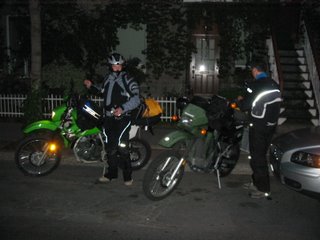
We rode through a heavy rain as far as Trois Rivieres, and then turned north for Shawinigan. I watched Sam avoid a collision on a combined on/off ramp. I soon did the same. Add another small blessing to the pile.
The bikes performed admirably, as did my gear. Pushing through the rain at 110, I was quite certain I was prepared for the elements farther down the road. After a couple of hours of solid and straight riding we stopped in Shawinigan for dinner. We had set reaching Roberval as our goal, but night and fatigue overcame our best intentions. Winding along the Grane Mere, we finally stopped in Parc des Chutes, just south of La Tuque. We’d pushed 300 kms through the fog and rain. We quickly found a patch of grass beside a parking lot and set up tent. My head went down at 2 am only to be followed by a fitful sleep. I was nervous about the North Road.
Camp in the morning

Sam and I were both awake at 6 am. I think his sleep was like mine. We were both staring down a long day in the saddle and we both wanted to make time. We packed up and scored breakfast in La Tuque at a small truckstop. We then saddled up and pushed into grey clouds and fog.
The gray lifted as we crested a hill over Lac St Jean. Lucien Bouchard once said he would have been a federalist if he had visited Vancouver when he was young. Seeing the sun shine over the Saugenay, with blue mountains across the lake and farm land stretching out forever I was for a moment a sovereigntist. This is enough beauty for one country.
We turned left at Roberval and stopped in at a Canadian Tire for some gear additions. It was noon by now, but we were still cold. We bought more gloves and hot packs for the ride up north. All told, would we finish the day about 450 kilometers farther north, and in near-Taiga. We tried to prepare for the worst.
After we suited up again we headed for Chibougamau, doing to 250 kms in one hit. Sam led most of the way, and I was happy to follow. He is the perfect riding partner. Cautious, but not slow. Adventurous, but not careless. And he is always willing to push a bit farther.
By late afternoon we had reached Chibo. Fifteen kilometers north of the city we found the Route du Nord. Originally built to access cut blocks and hydro projects, the road winds some 400 kms across northern Quebec, running west and then turning North. During the week, the road is filled with logging trucks. As we are running on a Saturday, we are all alone. In the 300 kms we cover on Saturday, we see less than ten cars! Mostly, it is just skimming along on top of the gravel. The guides I have read suggest observing the speed limit, which is just 70 km/h. This is clearly too slow, and soon Sam and I are pushing 110, eyes peeled for large rocks, fighting occasionally against front-wheel dives in the berms, and always keeping an eye out for animals. The bikes love this terrain. We let a distance grow between us, so we are not riding in each other’s dust. We stop to meet up ever hour or so. This is the ride we’ve been waiting for: challenging, isolated, fast, and adventurous. We grin from ear to ear.
Somewhere in the middle of nowhere
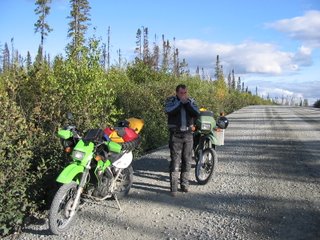
It is in the corners that the counter intuitions of a motorcycle become clear. At speed, your wheels want to slide out under the gravel, and the bike wants you to take a straight line to the outside of the corner. The mind tells you to slow down, lean forward, and steer into the corner. The mind is wrong on three counts. Rather, you punch the throttle, stand up a little on the outside peg, and push the bars away from the inside corner. The bike leans and grabs a line and shoots out the corner. Everything you thought was right was wrong.
After 250 kms the sun is diving behind the hills and night is coming fast. We resolve to push as far as Nemaska, where we can get gas for the first time in 300 kms. We will decide then whether to spend the night.
Soon after this we cross the Rupert River. Seeing the river is part of the reason for the trip. The Rupert flows like an artery across the middle of Quebec, emptying millions of gallons of fresh water into the bottom of James Bay. It is spine-shattering rapids and wide, sweeping swathes of water. It will be diverted next year for a hydro project. But for now it flows, and we were keen to see it in all of its majesty. It was literally breath taking.
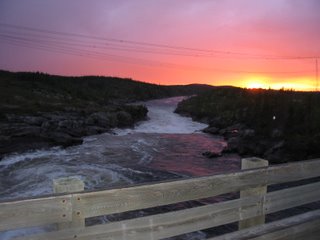
As we looked out over the river we saw a campfire on a landing above the rapids. We then turned around to see a fellow casually strolling down the bridge toward us. In the middle of nowhere we met Benoit, a Frenchman now living in Trois Riviere. He regularly camps alone in Quebec’s wilds. We enjoyed his brief company immensely, and he obliged us and took a picture of Sam and me above the rapids.
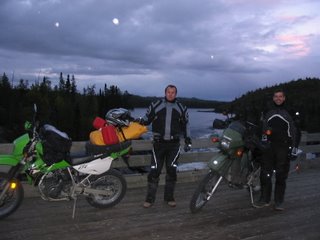
We then pushed on for Nemaska, a native town at kilometer three hundred. We had traveled 700 kms by the time we arrived, and decided to call it a day. But first we rode across a narrow isthmus into the town and gassed up. David, the station attendant, told us we could stay on the beach of the narrows. He said normally we could stay on the beach at the other side of the town, but everyone was there for a wedding party. So we headed back out the narrows and found the most beautiful campsite. A beach ran along a bay on Lake Campion. We pitched our tent and set to making dinner. We soon welcomed what seemed like a parade of visitors. Each one stopped to make sure we were alright. A village elder named Sam offered us the hospitality of his home. We declined, but he did accept our invitation to tea. He told us the story of his birth, brought forth in the bush by the light of embers. The candles had run out. He told us how Nemaska had been built after Hydro Quebec flooded his old home. He told us of his camps all over the region, explained the Caribou and moose hunting seasons, answered all our questions about the local fishing. And then he moved on, but not before extending an offer of lodging again. His welcome warms me still.
Sam and I woke up early in Nemaska with all the narrows covered in fog. We could only take the locals’ word about the beauty of Lake Campion.
We made a quick breakfast and packed up the bikes. We would ride another 100 kms of gravel north west, and then meet the James Bay Highway at kilometer 275. Pushing along near top speed on the gravel we ate up the road in an hour’s time.
The JBH – North Road intersection

When we reached the JBH we had only 434 kilometers to Chisasibi. It is counterintuitive how the miles accumulate when you are this isolated. When you ride through a populated area every town and rest stop reminds you that you are traveling a long distance. But left with only long sweeping curves, burned out forests, small mountains in the distance and lake after lake, the distance becomes arbitrary. Instead, the mind is on holding the finest line through the corner and keeping the bike at top speed despite admonitions to drop to 85 km/h. The KLR is a fine bike, and bulletproof. But it’s on roads like the JBH – wide-open and unpatrolled – when I wish I had a bike that could easily cruise at 150 or 160 km/h, like this or this. All in good time.
About an hour after entering the highway we came upon Relais 381. It is a town – of sorts – at kilometer 381 of the JBH. It exists to pump gas at exorbirant prices and charge $1 for two day old hard boiled eggs. Sam says it’s the crappiest town in Canada. I reserve comment.
Relais 381 on the ride back
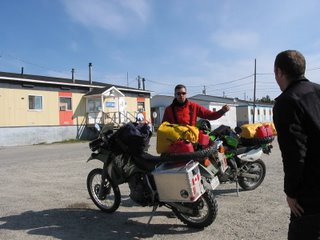
Fuel tanks filled, we took off at just after noon for Chisasibi. On the way we passed the Trans-Taiga road, a 700 km eastward ride into the middle of nowhere. At its end you lie farther from a town than on any other road in North America. We were taken by its isolation, and pointed the bikes down it. But time would not permit the trip this time.
The start of the Trans-Taiga

We arrived three hours later. A mostly native town, Chisasibi sits 90 kilometers west of the JBH on the La Grande river, just downstream from the great LG1 hydroelectric dam, and just ten kilometers upstream from James Bay. We pushed beyond the town looking for some trail to James Bay.
Somehow we ended up on ATV dual track which kept getting thicker and thicker, turning towards and then away from the river. When we decided this was not the way to the bay we turned around and started a back track. Anxious to get to the bay I kicked up the speed of the bike and upshifted a couple of times. Riding in deep ruts, this was a bad idea. It was only a matter of seconds before I hit a bad series of bumps and inadvertently hit the throttle. The bike rocketed ahead, then over, they into a tree. I ended up beside it and ahead of it. Laying on the trail I took a few deep breathes and gave everything the once over. Trailing not far behind, Sam inspected everything. I then made my way back to the bike, which fared better than the tree. The front wheel and fork where fine. Nothing was broken, and the mirrors but needed adjustment. At this point I got mad at Sam for not taking pictures of the crash. He wanted to make sure I was fine before snapping pics. That’s what friends are for, apparently.
The bike after the crash
Back at speed, we left the trail and then found the three lane wide dirt road which leads to the Bay. Apparently our observational skills match our navigational skills.
We passed a steady stream of pick up trucks and cars on our way to the Bay, and arrived after ten minutes. All the riding had been worth it. I cannot imagine a better scene. The water stretches past the horizon, the sky goes on forever, rocks come up from the water at low tide, and fishing boats and drying racks dot the shore. The flow of Le Grande is great enough that you can taste just a trace of salt in the water. We considered cooking dinner on the shore, but the air was getting colder and we knew we had a long ride to the Rupert River at km 257, where we hoped to spend the night. So we decided on dinner in Chisasibi and a long ride through the night to the Rupert. We’d never make it that far.
James Bay
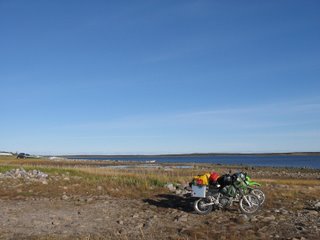
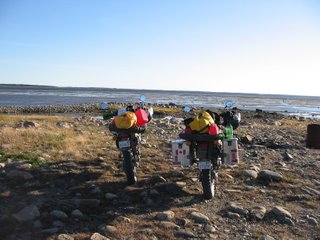
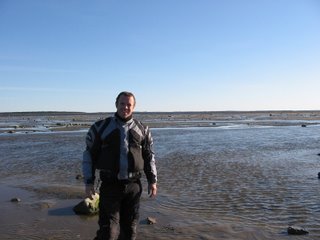
After Sam and I left the shore we headed to Chisasibi for dinner. Food in our bellies, we would ride in the dark to the Rupert River at kilometer 257. For those counting, that’s 90 kilometers out from Chisasibi, and then 343 kilometers on the JBH.
On the way out of Chisasibi we took a quick detour to see LG1, one of the great hydroelectric dams of northern Quebec. My eyes don’t see well at dusk, so it was a fine time to get off the bikes for a few minutes. We soon discovered that we could ride across the top of the dam, and then to a viewing platform downriver. It is hard to capture the scale of the barrage, but it is 1.3 kilometers wide and 160 meters in height.
Downstream at Le Grande
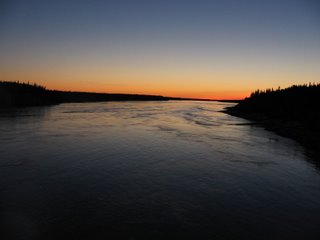
LG-1
The sun completely down, we set off for the JBH. By the time we reached the highway I was freezing. The temperature had dropped close to freezing, which makes it several degrees colder at speed. We stopped to regroup, adding whatever layers we had. We also used the last of our heatpacks. It was ultimately all for not. Within 100 kilometers I could barely keep my legs from shaking, and my speed was dropping continuously, a tell-tale sign of fatigue. Soon after that I was convinced I could see frost on the trees, and the miles rolled by dreadfully slowly. What seemed like an hour would pass and we’d be just ten kilometers closer to our goal. The steady stream of northbound logging trucks soon proved a hazard, as I began to fear drifting across lanes, especially as it became more difficult to hold our lines through the corners. Then, at km 470, we hit a fog which swallowed our front wheels. It was only with good fortune that we were alongside Lake Mistanikap, dotted with Cree summer camps. We set up camp as quickly as we could. Chilled to the core, I slept in all my gear.
I woke up late the next morning. It had been an awful ride the night before. And today we had 1100 kms to home. Still, I looked forward to the challenge. Even when I pushed my head outside of the tent and proceeded to cough up a bunch of blood.
The camp in morning
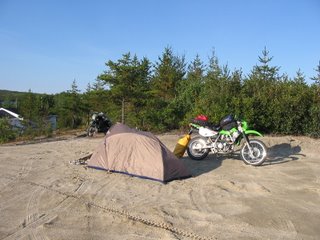
We tried to be efficient in cleaning up camp, but the long night had gotten the better of us. Sam dropped his bike in the sand twice. I almost dropped mine once (and had dropped it twice the day before). But we soon resolved ourselves to the task and set out. We rode a hard pace to Relais 381 where we would gas up for our longest stretch yet without fuel. Then, filled up on some mixture of Red Bull, ginseng, and Gatorade, we headed for Matagami. It’s hardly heavy fuel, but it will keep you eyes up on the bike.
At km 257 we finally hit the Rupert. We had crossed it earlier on the North Road, but there the river was nothing like it is here. By the time the Rupert crosses the JBH is has collected much more water, as several more lakes spill into its stream. I had seen pictures before, but they did nothing to capture the scale of the rapids. It takes little to imagine the most calm line leading to smashed canoes. And it is inconceivable that one could run the roughest section of the cataracts. This is, quite literally, a deadly river. It is a kilometer of crashing. crushing rapids. There is nothing calm or serene about it. The Queen of the North, it is one of Quebec’s greatest possessions. As I’ve written below, this is not for much longer. Sam and I briefly discussed the merits of damming the river, given how much power it will provide and how much wealth will accrue to the Cree nations as a result. But it really doesn’t make up for the loss. We had little time to stay – we had to get back to jobs and studies. Life rolls on like the Rupert, apparently. Until it doesn’t.
The Rupert River
From the Rupert we rode a little less than 900 kilometers home. I rode about 80 more than Sam, on account of his bike breaking down in the Gatineaus. The cause remains unknown, despite he and I performing a number of simple tests on the roadside, guided by my dad on a cellphone. I ended up winding the last 80 kilometers home following a tow truck with Sam’s bike. It was a poor ending to an extraordinary trip, the thoughts of which keep flowing.
View Larger Map
Sam and I left for James Bay on Friday night. We’d been planning for a couple of months to travel to Chisasibi, a native town on the northeast corner of the bay. It’s a fairly simple, if long ride. After winding your way 670 kms from Ottawa to Matagami, you get on the James Bay Highway and drive north on the same road for 600 kms. Some time after passing the 52nd parallel you turn left and head to the Bay. However, we decided to complicate the trip. We would first head to Chibougamau, 250 kms north of Lac Saint Jean, and then travel the Route du Nord 400 kms to the JBH.
We suited up on Friday night and left later than we should have. Michael Ignatieff is to blame, but that is another story.
Leaving the Plateau
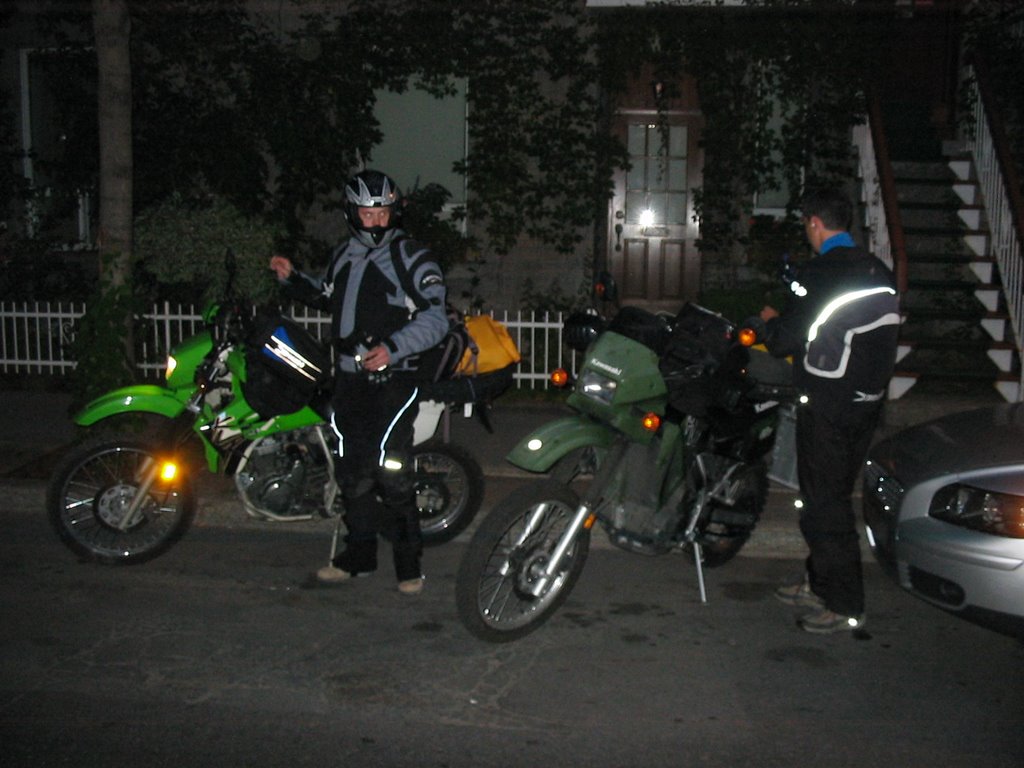
We rode through a heavy rain as far as Trois Rivieres, and then turned north for Shawinigan. I watched Sam avoid a collision on a combined on/off ramp. I soon did the same. Add another small blessing to the pile.
The bikes performed admirably, as did my gear. Pushing through the rain at 110, I was quite certain I was prepared for the elements farther down the road. After a couple of hours of solid and straight riding we stopped in Shawinigan for dinner. We had set reaching Roberval as our goal, but night and fatigue overcame our best intentions. Winding along the Grane Mere, we finally stopped in Parc des Chutes, just south of La Tuque. We’d pushed 300 kms through the fog and rain. We quickly found a patch of grass beside a parking lot and set up tent. My head went down at 2 am only to be followed by a fitful sleep. I was nervous about the North Road.
Camp in the morning
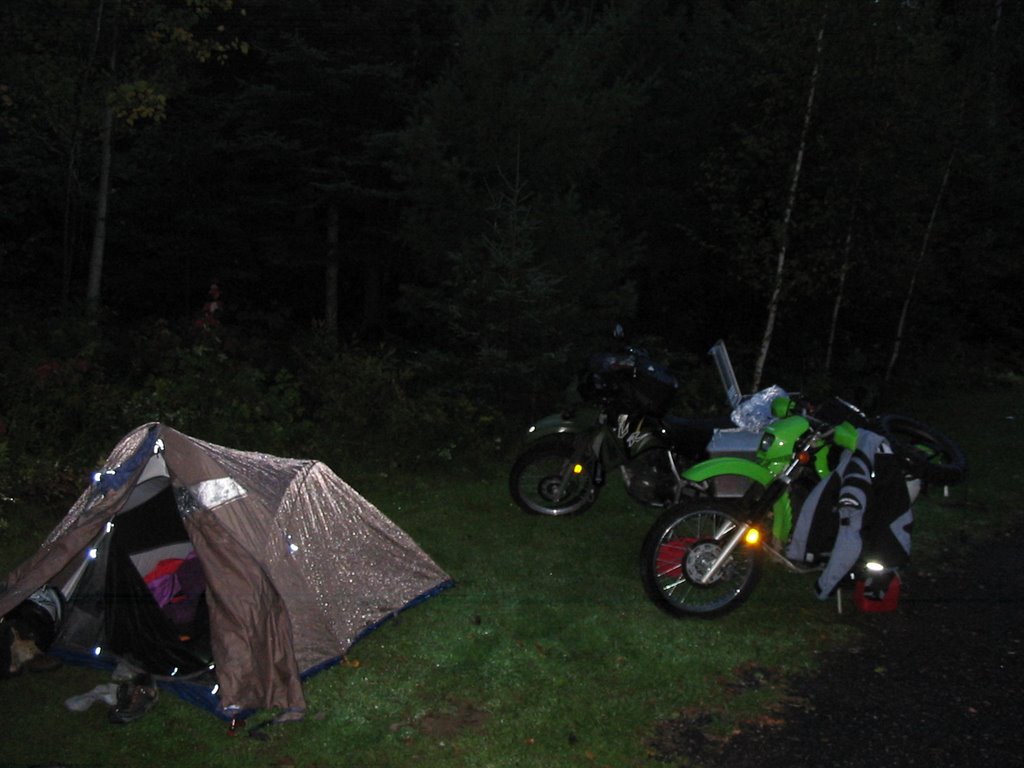
Sam and I were both awake at 6 am. I think his sleep was like mine. We were both staring down a long day in the saddle and we both wanted to make time. We packed up and scored breakfast in La Tuque at a small truckstop. We then saddled up and pushed into grey clouds and fog.
The gray lifted as we crested a hill over Lac St Jean. Lucien Bouchard once said he would have been a federalist if he had visited Vancouver when he was young. Seeing the sun shine over the Saugenay, with blue mountains across the lake and farm land stretching out forever I was for a moment a sovereigntist. This is enough beauty for one country.
We turned left at Roberval and stopped in at a Canadian Tire for some gear additions. It was noon by now, but we were still cold. We bought more gloves and hot packs for the ride up north. All told, would we finish the day about 450 kilometers farther north, and in near-Taiga. We tried to prepare for the worst.
After we suited up again we headed for Chibougamau, doing to 250 kms in one hit. Sam led most of the way, and I was happy to follow. He is the perfect riding partner. Cautious, but not slow. Adventurous, but not careless. And he is always willing to push a bit farther.
By late afternoon we had reached Chibo. Fifteen kilometers north of the city we found the Route du Nord. Originally built to access cut blocks and hydro projects, the road winds some 400 kms across northern Quebec, running west and then turning North. During the week, the road is filled with logging trucks. As we are running on a Saturday, we are all alone. In the 300 kms we cover on Saturday, we see less than ten cars! Mostly, it is just skimming along on top of the gravel. The guides I have read suggest observing the speed limit, which is just 70 km/h. This is clearly too slow, and soon Sam and I are pushing 110, eyes peeled for large rocks, fighting occasionally against front-wheel dives in the berms, and always keeping an eye out for animals. The bikes love this terrain. We let a distance grow between us, so we are not riding in each other’s dust. We stop to meet up ever hour or so. This is the ride we’ve been waiting for: challenging, isolated, fast, and adventurous. We grin from ear to ear.
Somewhere in the middle of nowhere
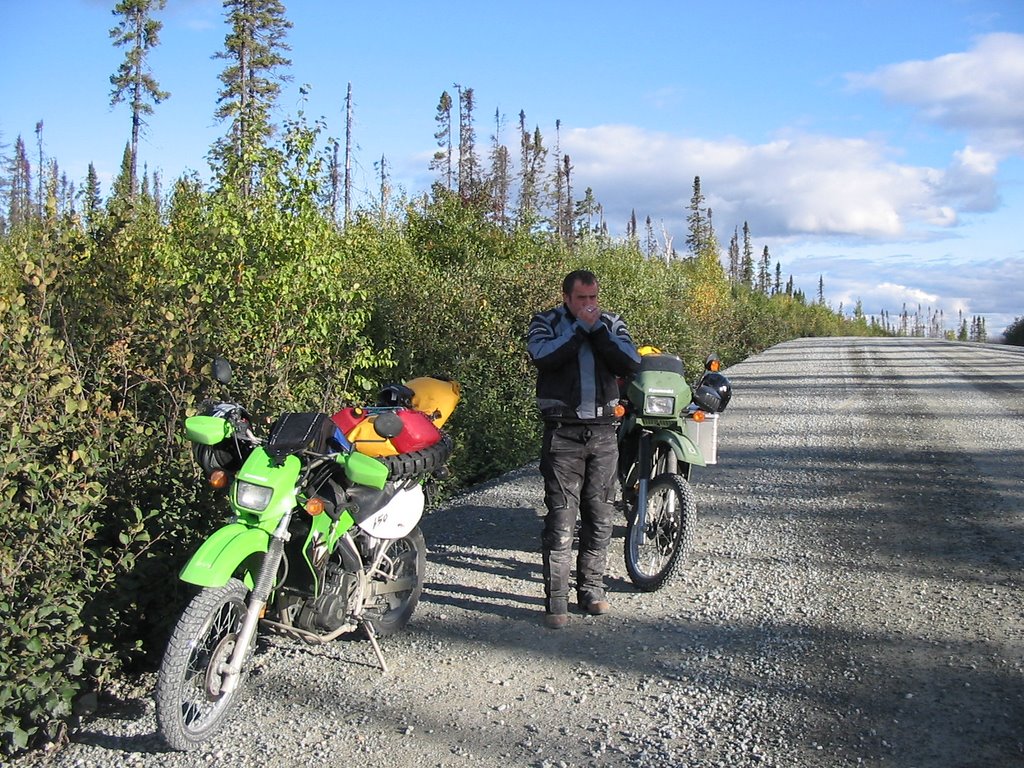
It is in the corners that the counter intuitions of a motorcycle become clear. At speed, your wheels want to slide out under the gravel, and the bike wants you to take a straight line to the outside of the corner. The mind tells you to slow down, lean forward, and steer into the corner. The mind is wrong on three counts. Rather, you punch the throttle, stand up a little on the outside peg, and push the bars away from the inside corner. The bike leans and grabs a line and shoots out the corner. Everything you thought was right was wrong.
After 250 kms the sun is diving behind the hills and night is coming fast. We resolve to push as far as Nemaska, where we can get gas for the first time in 300 kms. We will decide then whether to spend the night.
Soon after this we cross the Rupert River. Seeing the river is part of the reason for the trip. The Rupert flows like an artery across the middle of Quebec, emptying millions of gallons of fresh water into the bottom of James Bay. It is spine-shattering rapids and wide, sweeping swathes of water. It will be diverted next year for a hydro project. But for now it flows, and we were keen to see it in all of its majesty. It was literally breath taking.
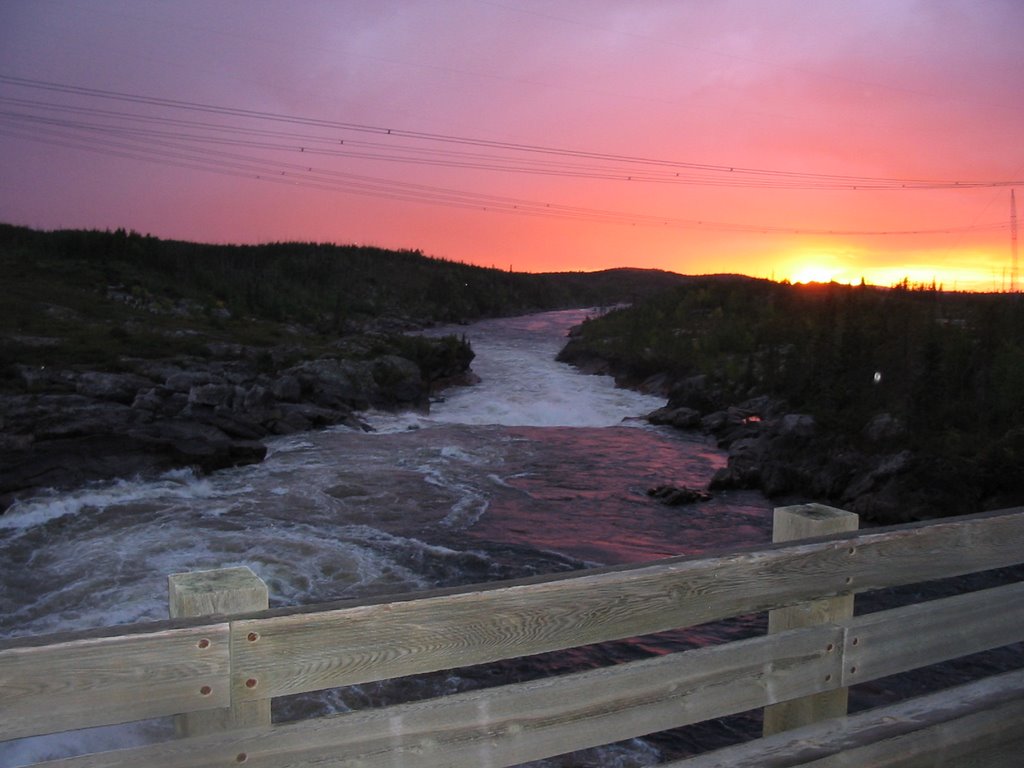
As we looked out over the river we saw a campfire on a landing above the rapids. We then turned around to see a fellow casually strolling down the bridge toward us. In the middle of nowhere we met Benoit, a Frenchman now living in Trois Riviere. He regularly camps alone in Quebec’s wilds. We enjoyed his brief company immensely, and he obliged us and took a picture of Sam and me above the rapids.

We then pushed on for Nemaska, a native town at kilometer three hundred. We had traveled 700 kms by the time we arrived, and decided to call it a day. But first we rode across a narrow isthmus into the town and gassed up. David, the station attendant, told us we could stay on the beach of the narrows. He said normally we could stay on the beach at the other side of the town, but everyone was there for a wedding party. So we headed back out the narrows and found the most beautiful campsite. A beach ran along a bay on Lake Campion. We pitched our tent and set to making dinner. We soon welcomed what seemed like a parade of visitors. Each one stopped to make sure we were alright. A village elder named Sam offered us the hospitality of his home. We declined, but he did accept our invitation to tea. He told us the story of his birth, brought forth in the bush by the light of embers. The candles had run out. He told us how Nemaska had been built after Hydro Quebec flooded his old home. He told us of his camps all over the region, explained the Caribou and moose hunting seasons, answered all our questions about the local fishing. And then he moved on, but not before extending an offer of lodging again. His welcome warms me still.
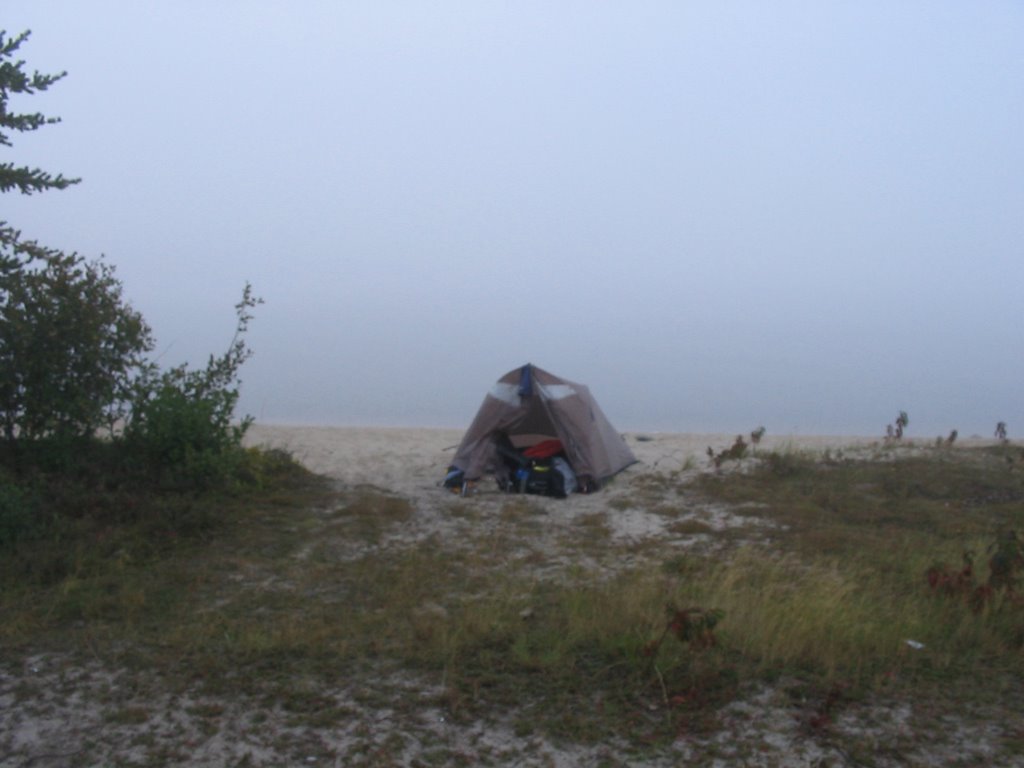
Sam and I woke up early in Nemaska with all the narrows covered in fog. We could only take the locals’ word about the beauty of Lake Campion.
We made a quick breakfast and packed up the bikes. We would ride another 100 kms of gravel north west, and then meet the James Bay Highway at kilometer 275. Pushing along near top speed on the gravel we ate up the road in an hour’s time.
The JBH – North Road intersection

When we reached the JBH we had only 434 kilometers to Chisasibi. It is counterintuitive how the miles accumulate when you are this isolated. When you ride through a populated area every town and rest stop reminds you that you are traveling a long distance. But left with only long sweeping curves, burned out forests, small mountains in the distance and lake after lake, the distance becomes arbitrary. Instead, the mind is on holding the finest line through the corner and keeping the bike at top speed despite admonitions to drop to 85 km/h. The KLR is a fine bike, and bulletproof. But it’s on roads like the JBH – wide-open and unpatrolled – when I wish I had a bike that could easily cruise at 150 or 160 km/h, like this or this. All in good time.
About an hour after entering the highway we came upon Relais 381. It is a town – of sorts – at kilometer 381 of the JBH. It exists to pump gas at exorbirant prices and charge $1 for two day old hard boiled eggs. Sam says it’s the crappiest town in Canada. I reserve comment.
Relais 381 on the ride back
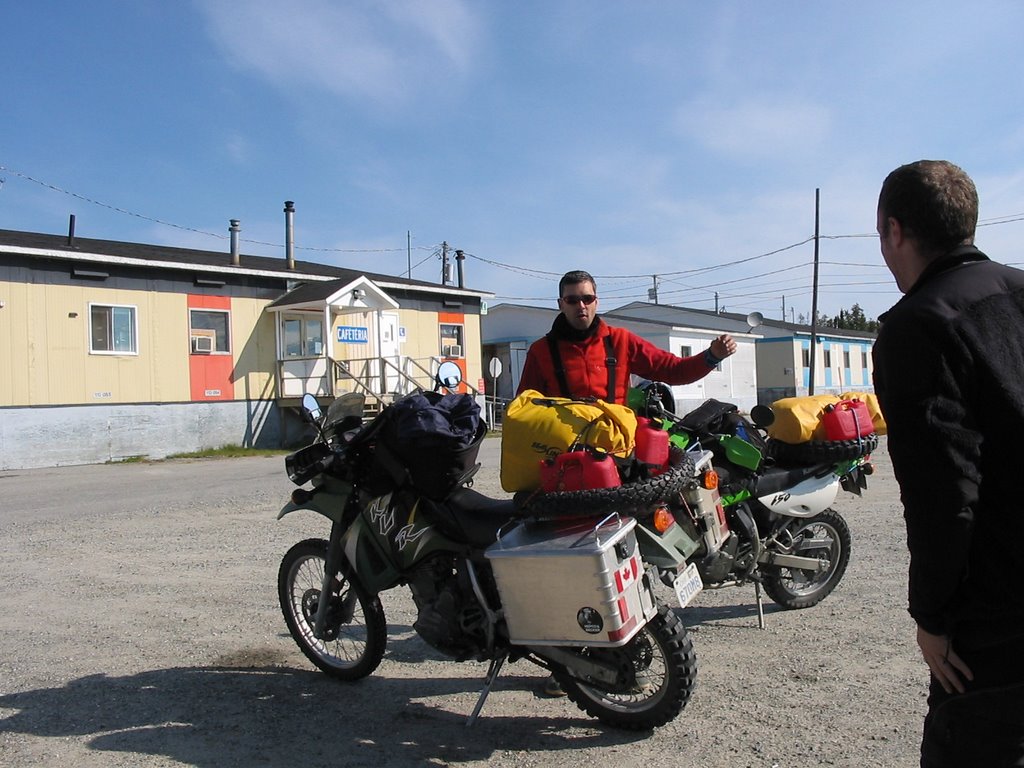
Fuel tanks filled, we took off at just after noon for Chisasibi. On the way we passed the Trans-Taiga road, a 700 km eastward ride into the middle of nowhere. At its end you lie farther from a town than on any other road in North America. We were taken by its isolation, and pointed the bikes down it. But time would not permit the trip this time.
The start of the Trans-Taiga

We arrived three hours later. A mostly native town, Chisasibi sits 90 kilometers west of the JBH on the La Grande river, just downstream from the great LG1 hydroelectric dam, and just ten kilometers upstream from James Bay. We pushed beyond the town looking for some trail to James Bay.
Somehow we ended up on ATV dual track which kept getting thicker and thicker, turning towards and then away from the river. When we decided this was not the way to the bay we turned around and started a back track. Anxious to get to the bay I kicked up the speed of the bike and upshifted a couple of times. Riding in deep ruts, this was a bad idea. It was only a matter of seconds before I hit a bad series of bumps and inadvertently hit the throttle. The bike rocketed ahead, then over, they into a tree. I ended up beside it and ahead of it. Laying on the trail I took a few deep breathes and gave everything the once over. Trailing not far behind, Sam inspected everything. I then made my way back to the bike, which fared better than the tree. The front wheel and fork where fine. Nothing was broken, and the mirrors but needed adjustment. At this point I got mad at Sam for not taking pictures of the crash. He wanted to make sure I was fine before snapping pics. That’s what friends are for, apparently.
The bike after the crash

Back at speed, we left the trail and then found the three lane wide dirt road which leads to the Bay. Apparently our observational skills match our navigational skills.
We passed a steady stream of pick up trucks and cars on our way to the Bay, and arrived after ten minutes. All the riding had been worth it. I cannot imagine a better scene. The water stretches past the horizon, the sky goes on forever, rocks come up from the water at low tide, and fishing boats and drying racks dot the shore. The flow of Le Grande is great enough that you can taste just a trace of salt in the water. We considered cooking dinner on the shore, but the air was getting colder and we knew we had a long ride to the Rupert River at km 257, where we hoped to spend the night. So we decided on dinner in Chisasibi and a long ride through the night to the Rupert. We’d never make it that far.
James Bay


After Sam and I left the shore we headed to Chisasibi for dinner. Food in our bellies, we would ride in the dark to the Rupert River at kilometer 257. For those counting, that’s 90 kilometers out from Chisasibi, and then 343 kilometers on the JBH.
On the way out of Chisasibi we took a quick detour to see LG1, one of the great hydroelectric dams of northern Quebec. My eyes don’t see well at dusk, so it was a fine time to get off the bikes for a few minutes. We soon discovered that we could ride across the top of the dam, and then to a viewing platform downriver. It is hard to capture the scale of the barrage, but it is 1.3 kilometers wide and 160 meters in height.
Downstream at Le Grande

LG-1

The sun completely down, we set off for the JBH. By the time we reached the highway I was freezing. The temperature had dropped close to freezing, which makes it several degrees colder at speed. We stopped to regroup, adding whatever layers we had. We also used the last of our heatpacks. It was ultimately all for not. Within 100 kilometers I could barely keep my legs from shaking, and my speed was dropping continuously, a tell-tale sign of fatigue. Soon after that I was convinced I could see frost on the trees, and the miles rolled by dreadfully slowly. What seemed like an hour would pass and we’d be just ten kilometers closer to our goal. The steady stream of northbound logging trucks soon proved a hazard, as I began to fear drifting across lanes, especially as it became more difficult to hold our lines through the corners. Then, at km 470, we hit a fog which swallowed our front wheels. It was only with good fortune that we were alongside Lake Mistanikap, dotted with Cree summer camps. We set up camp as quickly as we could. Chilled to the core, I slept in all my gear.
I woke up late the next morning. It had been an awful ride the night before. And today we had 1100 kms to home. Still, I looked forward to the challenge. Even when I pushed my head outside of the tent and proceeded to cough up a bunch of blood.
The camp in morning

We tried to be efficient in cleaning up camp, but the long night had gotten the better of us. Sam dropped his bike in the sand twice. I almost dropped mine once (and had dropped it twice the day before). But we soon resolved ourselves to the task and set out. We rode a hard pace to Relais 381 where we would gas up for our longest stretch yet without fuel. Then, filled up on some mixture of Red Bull, ginseng, and Gatorade, we headed for Matagami. It’s hardly heavy fuel, but it will keep you eyes up on the bike.
At km 257 we finally hit the Rupert. We had crossed it earlier on the North Road, but there the river was nothing like it is here. By the time the Rupert crosses the JBH is has collected much more water, as several more lakes spill into its stream. I had seen pictures before, but they did nothing to capture the scale of the rapids. It takes little to imagine the most calm line leading to smashed canoes. And it is inconceivable that one could run the roughest section of the cataracts. This is, quite literally, a deadly river. It is a kilometer of crashing. crushing rapids. There is nothing calm or serene about it. The Queen of the North, it is one of Quebec’s greatest possessions. As I’ve written below, this is not for much longer. Sam and I briefly discussed the merits of damming the river, given how much power it will provide and how much wealth will accrue to the Cree nations as a result. But it really doesn’t make up for the loss. We had little time to stay – we had to get back to jobs and studies. Life rolls on like the Rupert, apparently. Until it doesn’t.
The Rupert River
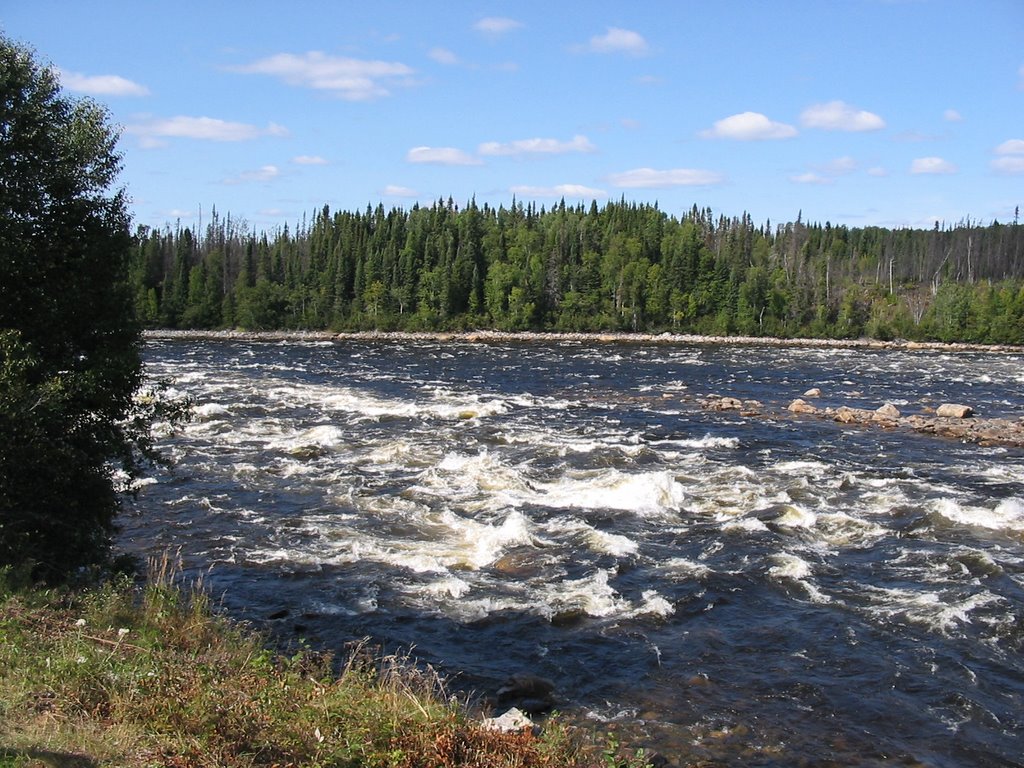

From the Rupert we rode a little less than 900 kilometers home. I rode about 80 more than Sam, on account of his bike breaking down in the Gatineaus. The cause remains unknown, despite he and I performing a number of simple tests on the roadside, guided by my dad on a cellphone. I ended up winding the last 80 kilometers home following a tow truck with Sam’s bike. It was a poor ending to an extraordinary trip, the thoughts of which keep flowing.
Net Gains 4.0: $50,000
As foreshadowed by Peter in a previous posting, it’s time to announce a new fundraising objective for Spread the Net. You all were so generous that we came close to meeting our initial goal in only a couple of weeks… Since this whole adventure is firmly rooted in a sense of realistic challenge (provided we are issued visas to Sudan), it just seemed a little too easy. And besides, Spread the Net is a REALLY good cause.
So, we are setting our sights on raising $50,000, or the equivalent of 5,000 nets. Clearly, reaching this new, higher objective is going to take us some time, but we look forward to holding some events and finding other creative ways to support an organisation that is really effective at alleviating malaria.
If you are interested in learning a little more about why bed nets are one of the best ways to reduce malaria, this recent article published in the Economist is a good summary. For some time there has been a really interesting debate about whether it’s best to give malarial nets away for free or sell them. New research from the World Health Organisation shows that giving them away is actually preferable. UNICEF, which is the implementing partner for Spread the Net, gives the nets to individuals most vulnerable to malaria (children under 5, pregnant women and persons with HIV/Aids).
On a personal note, it’s hard to believe this is my first blog posting ever (I’m definitely going to be the old man on this trip…). Anyway things have changed dramatically in my own life over the past week; I moved from Ottawa to Afghanistan. For the next months I will be working at Canada’s Provincial Reconstruction Team in Kandahar City doing a review of CIDA’s operations in the province. Under normal circumstances my jetting off might have left our trip in the lurch, so it must be said that Peter is truly a saint as he has offered to handle many of the preparations from Canada. There is a fair bit to do and while I’ll try to do my bit from over here, I will be mostly focussed on the task at hand, situated on the other side of the world and living in a context of great instability. You'll have to forgive me if I don’t post on this blog all that often.
So, we are setting our sights on raising $50,000, or the equivalent of 5,000 nets. Clearly, reaching this new, higher objective is going to take us some time, but we look forward to holding some events and finding other creative ways to support an organisation that is really effective at alleviating malaria.
If you are interested in learning a little more about why bed nets are one of the best ways to reduce malaria, this recent article published in the Economist is a good summary. For some time there has been a really interesting debate about whether it’s best to give malarial nets away for free or sell them. New research from the World Health Organisation shows that giving them away is actually preferable. UNICEF, which is the implementing partner for Spread the Net, gives the nets to individuals most vulnerable to malaria (children under 5, pregnant women and persons with HIV/Aids).
On a personal note, it’s hard to believe this is my first blog posting ever (I’m definitely going to be the old man on this trip…). Anyway things have changed dramatically in my own life over the past week; I moved from Ottawa to Afghanistan. For the next months I will be working at Canada’s Provincial Reconstruction Team in Kandahar City doing a review of CIDA’s operations in the province. Under normal circumstances my jetting off might have left our trip in the lurch, so it must be said that Peter is truly a saint as he has offered to handle many of the preparations from Canada. There is a fair bit to do and while I’ll try to do my bit from over here, I will be mostly focussed on the task at hand, situated on the other side of the world and living in a context of great instability. You'll have to forgive me if I don’t post on this blog all that often.
Saturday, March 1, 2008
The Soundtrack of Our Lives
The Great Anamitra Deb is going to put together a soundtrack for our trip. But in case he doesn't, I'd like you, the faithful reader, to do so. We'll call it Volume 2.
I remember my life through music. I associate songs with friends, places I've lived, meals I've eaten, even the most precisely recalled but meaningless moments. I've taken to listening to my iPod when I ride. As a consequence, I can recall the precise moment in LCD Soundsystem's "All My Friends" when Sam and I came upon a long line of cyclists along Route 138, just east of Forestville on our way to the Trans-Lab highway.
I can remember, too, exactly what it was like riding out of Labrador City at 7 am, in a cold rain, and seeing a sign declaring it was prohibited to shoot caribou within 50 metres of the highway. I was listening to the Arcade Fire's "Keep the Car Running":
If some night I don't come home
Please don't think I've left you alone
The same place animals go when they die.
You can't climb across a mountain so high
Those lyrics will for a long time be tied to my trepidation that morning . If caribou could be shot on the road then they could also certainly come into our path. But they also remind me of how great was my feeling when we arrived for the ferry on time on a route others were convinced we couldn't beat the clock.
So, what songs are going to make the trip this time? They need only meet a few conditions. They should have a good beat, clever lyrics, and maybe geographic or travel references. You can email your suggestions and reasons at pjlwn@mta.ca, and I'll post all suggestions on the site.
I remember my life through music. I associate songs with friends, places I've lived, meals I've eaten, even the most precisely recalled but meaningless moments. I've taken to listening to my iPod when I ride. As a consequence, I can recall the precise moment in LCD Soundsystem's "All My Friends" when Sam and I came upon a long line of cyclists along Route 138, just east of Forestville on our way to the Trans-Lab highway.
I can remember, too, exactly what it was like riding out of Labrador City at 7 am, in a cold rain, and seeing a sign declaring it was prohibited to shoot caribou within 50 metres of the highway. I was listening to the Arcade Fire's "Keep the Car Running":
If some night I don't come home
Please don't think I've left you alone
The same place animals go when they die.
You can't climb across a mountain so high
Those lyrics will for a long time be tied to my trepidation that morning . If caribou could be shot on the road then they could also certainly come into our path. But they also remind me of how great was my feeling when we arrived for the ferry on time on a route others were convinced we couldn't beat the clock.
So, what songs are going to make the trip this time? They need only meet a few conditions. They should have a good beat, clever lyrics, and maybe geographic or travel references. You can email your suggestions and reasons at pjlwn@mta.ca, and I'll post all suggestions on the site.
Net Gains 3.0
At the two-week mark, we are now at 85% of our goal. So, it's time to increase it. The new goal shall be announced in due course.
Monday, February 25, 2008
Net Gains 2.0
Rather great news: We have now raised close to $4000 for Spread the Net. This is in less than 10 days of fundraising. Thanks so much to so many of our generous friends and those friends we've not yet met. We will soon be announcing a larger fundraising goal and will look forward to expanding the circle of those giving to this great cause.
Thanks again. It's awfully nice how many people have given to this great cause.
Thanks again. It's awfully nice how many people have given to this great cause.
The Impala is a Very Popular Automobile: On the Misunderstood Pleasures of Canoeing
Below is a shortened version of an essay I wrote up after Sam, his father, and our friend Maskull paddled the lower Rupert River last summer.
Our plan was simple. Sam’s father, Dave, would fly in from Vancouver on Tuesday night. I would arrive in Ottawa the next morning. Dave, Maskull and I would spend the day collecting supplies, two canoes, and a rental car. We’d leave Ottawa the next morning for the Rupert River, 900 kilometres north, where we’d take four days to paddle to Rupert Bay and then drive home.
It is a rather delicate matter to rent a car when one intends to strap two canoes to its roof without a proper rack, drive far into Northern Quebec, and then leave the car unattended for four days. First, no car is ideally suited for this. Second, no car rental agency wants to give you a car upon which you are going to mount two canoes. We booked a Chevy Impala, an incredibly pedestrian but flat-roofed car ideal for two canoes. We resolved to say nothing of our intention to load canoes atop the car.
Our first problem was that the agency had no Impalas. Our second was that they did not understand why we were refusing an upgrade to a Grand Prix. Standing at the rental desk, Dave and I pondered over the available cars, compared their virtues in a whispered exchange, and then asked when an Impala might be back. Clearly befuddled by our insistence, the clerk offered up that “The Impala is a very popular automobile. I can understand why you would want it.” The screwed-up skin between her eyebrows suggested she did not understand a thing. Hers was not a look of incredulity but bewilderment. We took a Grand Prix.
 All rigged up on the James Bay Highway.
***
The Rupert neither winds nor meanders. It runs a wide line 600 km from Lake Mistassini to Waskaganish, the old Fort Rupert on Rupert Bay, at the bottom of the James Bay. In low season, the river flows at 11,000 cubic feet per second. In high season, it flows at six times the rate and drains more than 40,000 square kilometres. It runs between high banks of scraggly spruce and pine. There is rarely a spot even to pull up a canoe, except those cleared by the Cree who travel this ancient highway.
The Rupert does not “flood its banks” or roar unceasingly down a canyon. Instead, it widens out into lakes for much of its length. The only crashing and running is through a series of narrow passes like the Oatmeal Rapids, a kilometre-long, spine-shattering collection of cascades. It alternates between slow water and probable death.

The bottom of the Oatmeal Rapids. Seen from the James Bay Highway.
The James Bay Highway crosses the river 225 kilometres north of Matagami, itself some 670 kilometres north of Ottawa. The journey begins in the bubbling water at the bottom of the Oatmeal Rapids, where the water spills into a bay and then takes a right turn towards White Beaver Rapids. It is just one hundred kilometres from here to the Bay, but one must still portage seven sets of rapids through muddy trails, alder stands, muskeg, and a moose pond. Or, one has to choose a line, steel nerves and spine, and then shoot the white water. We would do both, at great cost and joy.
***
Our first morning was glorious and cold. We put on extra layers, boiled water for oatmeal and coffee, discussed the day’s challenge and looked over maps. We set out and soon met near disaster.
Landing at the top of the first of the White Beaver rapids, we could not find a portage. Instead, we lugged canoes and gear through thick bush, taking more than an hour to travel less than a quarter mile. We dreaded the mile-long portages ahead, picturing them as day-long fights through the thicket.
Perhaps it was the difficulty of this first portage that compelled Dave and Maskull to run the second set of rapids. As Sam and I landed at the rapids’ head, they shot them. We soon saw a canoe overturned and pinned in a fall. Maskull and Dave stood astride their canoe in the running water. They were, somehow, holding their bags and keeping the canoe from folding over the rock.
The canoe was eventually freed; Maskull and Dave paddled a kinked canoe downstream in search of our food barrel. We were on the first day of a four-day trip, and we’d lost all of our fruit, our food barrel, our hatchet, and a few other sundries.
Sam and I warped our canoe through a rock garden around the rapids. When we met Dave and Maskull at the bottom they’d found the barrel in a bay at the bottom of the rapids. We all changed into the only dry clothes we had left, quickly ate something, and then set out. We still had to go some ninety kilometres to Waskaganish.
 Camp in the morning
***
It is not true that the rest of the trip was easy. To the contrary, it involved terribly long portages over some tough ground. On the second day, having left the Cat Rapids late afternoon after a difficult portage, we could not find a camping spot until the Bear Rapids, eventually setting up camp in long grass on a landing in the dark. Where we had contemplated luck and the stars the night before, camped on island in the bay between the second and third of the Fours, on this night we would collapse immediately after dinner. We took no joy in the sound of the waterfall ahead or in the accomplishment of paddling thirty kilometres and portaging five.
The next morning we paddled swiftly to Plum Pudding rapids, two sets of long white water. You avoid the first set by paddling a two-kilometre long braid on the south side of the river. After a short portage, you arrive at the water between the two sets. With some courage and short memory, we chose to shoot the second set. This was our greatest triumph. For two minutes we were voyageurs.

Shooting the Second Set of Plum Pudding
Fifteen kilometres later we arrived at Smoky Hill rapids. The portage counts out more than 5000 paces. It was the most difficult and rewarding portage of the trip. Just thirty kilometres from the Bay, the Cree still use nets to catch white fish at landing the bottom of the Smoky Hill rapids, as they have for five hundred years or more. The also use the landing as a recreation area. We had our greatest night here, finishing our last bottle of wine and eating a terribly good chilli. The locals who watched me swim in the rapids from across the river were the first people we had seen in three days.
The next morning was our last on the river and we took our time. As the river approaches the Bay it widens out and braids around a number of reed islands. We ate in our boats, passing around the last of our bagels and sausage. The water here is not quite brackish, but the change in the landscape must be a result of the ebb and flow of the ocean from Rupert Bay. We had just three sets of rapids - all steep, shallow and rocky – to the bay. We ran them all and then paddled onto Waskaganish.

The camp at Smoky Hill Rapids
***
Formerly Rupert House or Fort Rupert, Waskaganish lies half-way up Rupert Bay, which itself lies at the bottom of James Bay. It was the first fur trading post and store for the Hudson’s Bay Company. The Rupert provided a logical route inland to Quebec, a territory hostile to the HBC in its early days. The town was indeed captured by the French at the end of the 17th century and would not return to the Company’s control until 1776. As the Rupert is a great river soon to be dammed, we thought it would be full of paddlers; we were but the fourth group to travel to Waskaganish that summer.
Waskaganish is the third Cree town that Sam and I have visited, and certainly the most vibrant. This vibrancy and activity had a certain irony about it. When we visited Nemaska a summer before – arriving in the dark on our motorcycles and leaving early the next morning – the town seemed dead. The entire town was celebrating a wedding on a sandy point at the other side of the town, so we only met those who stopped by our campsite to visit.
By contrast, Waskaganish seemed full of people, most of them shuffling towards the lodge overlooking the river. But this was on account of death. When soon learned that the previous Friday two teenagers had drowned on a boat trip from Moosenee. At the same time we landed in Waskaganish, Cree were traveling from the other villages and camps for the funeral.
Maskull and I had volunteered to hitchhike back to the highway to get the car. Under these circumstances we were glad to take our leave. Sam and Dave stayed behind to pack our gear and mill about.
When we returned, we decided we would drive back through the night to Ottawa. With the sun coming up along Route 117 and Chelsea seeming like the calmest place on earth, we returned entirely fatigued and satisfied. We were soon to take our individual departures after dividing up the river maps and sorting out gear.

Arriving in Waskaganish
***
It was not long before I returned to my routine in Montreal. It was the same for Dave, Sam, and Maskull, I think. We exchanged emails in the days that followed, sent around pictures, and tried to put to words the joy of the outdoors and the pleasure of this trip.
I would spend the next weeks trying to explain this joy and pleasure to anyone who asked about our trip. How I relished loading up two bags and a barrel and heading into the bush. How I wanted to run more white water. Even how I relished the well-earned cuts and bruises, and how I felt as though I lived more in the five minutes after Maskull and Dave’s dump then I did in a year of academic work and travel.
I think most asked to be polite, but at least some friends and colleagues asked because they wanted to understand this desire to return, to spend one more night sleeping outside, and to run Plum Pudding one more time. I do not think I could ever explain it fully, in a way that could unknot the skin between their eyes. Canoeing is indeed a very popular sport, and the Impala is indeed a very popular automobile.
Our plan was simple. Sam’s father, Dave, would fly in from Vancouver on Tuesday night. I would arrive in Ottawa the next morning. Dave, Maskull and I would spend the day collecting supplies, two canoes, and a rental car. We’d leave Ottawa the next morning for the Rupert River, 900 kilometres north, where we’d take four days to paddle to Rupert Bay and then drive home.
It is a rather delicate matter to rent a car when one intends to strap two canoes to its roof without a proper rack, drive far into Northern Quebec, and then leave the car unattended for four days. First, no car is ideally suited for this. Second, no car rental agency wants to give you a car upon which you are going to mount two canoes. We booked a Chevy Impala, an incredibly pedestrian but flat-roofed car ideal for two canoes. We resolved to say nothing of our intention to load canoes atop the car.
Our first problem was that the agency had no Impalas. Our second was that they did not understand why we were refusing an upgrade to a Grand Prix. Standing at the rental desk, Dave and I pondered over the available cars, compared their virtues in a whispered exchange, and then asked when an Impala might be back. Clearly befuddled by our insistence, the clerk offered up that “The Impala is a very popular automobile. I can understand why you would want it.” The screwed-up skin between her eyebrows suggested she did not understand a thing. Hers was not a look of incredulity but bewilderment. We took a Grand Prix.
 All rigged up on the James Bay Highway.
***
The Rupert neither winds nor meanders. It runs a wide line 600 km from Lake Mistassini to Waskaganish, the old Fort Rupert on Rupert Bay, at the bottom of the James Bay. In low season, the river flows at 11,000 cubic feet per second. In high season, it flows at six times the rate and drains more than 40,000 square kilometres. It runs between high banks of scraggly spruce and pine. There is rarely a spot even to pull up a canoe, except those cleared by the Cree who travel this ancient highway.
The Rupert does not “flood its banks” or roar unceasingly down a canyon. Instead, it widens out into lakes for much of its length. The only crashing and running is through a series of narrow passes like the Oatmeal Rapids, a kilometre-long, spine-shattering collection of cascades. It alternates between slow water and probable death.

The bottom of the Oatmeal Rapids. Seen from the James Bay Highway.
The James Bay Highway crosses the river 225 kilometres north of Matagami, itself some 670 kilometres north of Ottawa. The journey begins in the bubbling water at the bottom of the Oatmeal Rapids, where the water spills into a bay and then takes a right turn towards White Beaver Rapids. It is just one hundred kilometres from here to the Bay, but one must still portage seven sets of rapids through muddy trails, alder stands, muskeg, and a moose pond. Or, one has to choose a line, steel nerves and spine, and then shoot the white water. We would do both, at great cost and joy.
***
Our first morning was glorious and cold. We put on extra layers, boiled water for oatmeal and coffee, discussed the day’s challenge and looked over maps. We set out and soon met near disaster.
Landing at the top of the first of the White Beaver rapids, we could not find a portage. Instead, we lugged canoes and gear through thick bush, taking more than an hour to travel less than a quarter mile. We dreaded the mile-long portages ahead, picturing them as day-long fights through the thicket.
Perhaps it was the difficulty of this first portage that compelled Dave and Maskull to run the second set of rapids. As Sam and I landed at the rapids’ head, they shot them. We soon saw a canoe overturned and pinned in a fall. Maskull and Dave stood astride their canoe in the running water. They were, somehow, holding their bags and keeping the canoe from folding over the rock.
The canoe was eventually freed; Maskull and Dave paddled a kinked canoe downstream in search of our food barrel. We were on the first day of a four-day trip, and we’d lost all of our fruit, our food barrel, our hatchet, and a few other sundries.
Sam and I warped our canoe through a rock garden around the rapids. When we met Dave and Maskull at the bottom they’d found the barrel in a bay at the bottom of the rapids. We all changed into the only dry clothes we had left, quickly ate something, and then set out. We still had to go some ninety kilometres to Waskaganish.
 Camp in the morning
***
It is not true that the rest of the trip was easy. To the contrary, it involved terribly long portages over some tough ground. On the second day, having left the Cat Rapids late afternoon after a difficult portage, we could not find a camping spot until the Bear Rapids, eventually setting up camp in long grass on a landing in the dark. Where we had contemplated luck and the stars the night before, camped on island in the bay between the second and third of the Fours, on this night we would collapse immediately after dinner. We took no joy in the sound of the waterfall ahead or in the accomplishment of paddling thirty kilometres and portaging five.
The next morning we paddled swiftly to Plum Pudding rapids, two sets of long white water. You avoid the first set by paddling a two-kilometre long braid on the south side of the river. After a short portage, you arrive at the water between the two sets. With some courage and short memory, we chose to shoot the second set. This was our greatest triumph. For two minutes we were voyageurs.

Shooting the Second Set of Plum Pudding
Fifteen kilometres later we arrived at Smoky Hill rapids. The portage counts out more than 5000 paces. It was the most difficult and rewarding portage of the trip. Just thirty kilometres from the Bay, the Cree still use nets to catch white fish at landing the bottom of the Smoky Hill rapids, as they have for five hundred years or more. The also use the landing as a recreation area. We had our greatest night here, finishing our last bottle of wine and eating a terribly good chilli. The locals who watched me swim in the rapids from across the river were the first people we had seen in three days.
The next morning was our last on the river and we took our time. As the river approaches the Bay it widens out and braids around a number of reed islands. We ate in our boats, passing around the last of our bagels and sausage. The water here is not quite brackish, but the change in the landscape must be a result of the ebb and flow of the ocean from Rupert Bay. We had just three sets of rapids - all steep, shallow and rocky – to the bay. We ran them all and then paddled onto Waskaganish.

The camp at Smoky Hill Rapids
***
Formerly Rupert House or Fort Rupert, Waskaganish lies half-way up Rupert Bay, which itself lies at the bottom of James Bay. It was the first fur trading post and store for the Hudson’s Bay Company. The Rupert provided a logical route inland to Quebec, a territory hostile to the HBC in its early days. The town was indeed captured by the French at the end of the 17th century and would not return to the Company’s control until 1776. As the Rupert is a great river soon to be dammed, we thought it would be full of paddlers; we were but the fourth group to travel to Waskaganish that summer.
Waskaganish is the third Cree town that Sam and I have visited, and certainly the most vibrant. This vibrancy and activity had a certain irony about it. When we visited Nemaska a summer before – arriving in the dark on our motorcycles and leaving early the next morning – the town seemed dead. The entire town was celebrating a wedding on a sandy point at the other side of the town, so we only met those who stopped by our campsite to visit.
By contrast, Waskaganish seemed full of people, most of them shuffling towards the lodge overlooking the river. But this was on account of death. When soon learned that the previous Friday two teenagers had drowned on a boat trip from Moosenee. At the same time we landed in Waskaganish, Cree were traveling from the other villages and camps for the funeral.
Maskull and I had volunteered to hitchhike back to the highway to get the car. Under these circumstances we were glad to take our leave. Sam and Dave stayed behind to pack our gear and mill about.
When we returned, we decided we would drive back through the night to Ottawa. With the sun coming up along Route 117 and Chelsea seeming like the calmest place on earth, we returned entirely fatigued and satisfied. We were soon to take our individual departures after dividing up the river maps and sorting out gear.

Arriving in Waskaganish
***
It was not long before I returned to my routine in Montreal. It was the same for Dave, Sam, and Maskull, I think. We exchanged emails in the days that followed, sent around pictures, and tried to put to words the joy of the outdoors and the pleasure of this trip.
I would spend the next weeks trying to explain this joy and pleasure to anyone who asked about our trip. How I relished loading up two bags and a barrel and heading into the bush. How I wanted to run more white water. Even how I relished the well-earned cuts and bruises, and how I felt as though I lived more in the five minutes after Maskull and Dave’s dump then I did in a year of academic work and travel.
I think most asked to be polite, but at least some friends and colleagues asked because they wanted to understand this desire to return, to spend one more night sleeping outside, and to run Plum Pudding one more time. I do not think I could ever explain it fully, in a way that could unknot the skin between their eyes. Canoeing is indeed a very popular sport, and the Impala is indeed a very popular automobile.
Subscribe to:
Posts (Atom)